


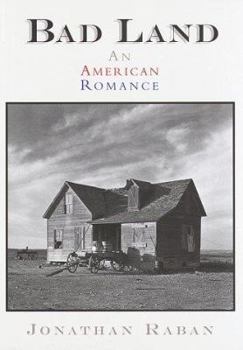
Bad Land: An American Romance


Select Format
Select Condition 
Book Overview
NATIONAL BESTSELLER - NATIONAL BOOK CRITICS CIRCLE AWARD WINNER - Startlingly observed, beautifully written, this book is a contemporary classic of the American West. - "As good a book as I have read... This description may be from another edition of this product.
Format:Hardcover
Language:English
ISBN:0679442545
ISBN13:9780679442547
Release Date:November 1996
Publisher:Pantheon
Length:324 Pages
Weight:1.30 lbs.
Dimensions:10.0" x 1.3" x 6.8"
Customer Reviews
3 ratings
Two years after reading it, I still can't forget it
Published by Thriftbooks.com User , 26 years ago
This is one of my favorite books...it really brought to life for me the odd mix of idealism and severe hardship of our midwestern settlers. Raban's style of story telling is relaxed and detail oriented, but once I'm into it, it has a life of its own....the writing is just incandescent. I could really imagine myself trying to get my family through a minus thirty degree winter with the wind howling through my thin wooden house, and hardly any food in the pantry. It seems that Raban's British sensibilities may have caused some unsatifying stereotyping of Montanans among his readers, but I didn't read this book to get a politically correct viewpoint. I read it because as much as any writer working today, Raban is able to let me experience the situations he is writing about. One of the very few books I have read twice.
One reason no one likes JP Hill
Published by Thriftbooks.com User , 27 years ago
Raban's such a good writer, I suppose I'd like any book he wrote (I'm going to find out shortly by getting hold of another). And that is the only reason I liked this book since the subject matter -- settlement of the Northern Plains around 1911 - 1920 -- does not, in itself, compel me. But then again, I didn't know much about it, and Raban very nicely introduced us. So many interesting things . . . how the drawing of the North Dakota / Montana state line around the 104th meridian split these otherwise similarly-sited people and diluted their political power; how the initial "wet years" of 1911 - 1914 gave such false hope, leading to such disillusionment, and eventually further emmigration west, as the "dry years" ensued and blew away their topsoil with their dreams; how they didn't wander into the area, but rather, were seduced into it by the railroads' (read JP Hill's) misrepresentation of the climate and land, the ease of "firming up" one's rather large homestead claim (hundreds of acres for a song), and the new "scientific" method of "dry farming" which promised to re-create the arcadia these settlers remembered from Europe. And I never thought much about hard it would be to build miles of barbed-wire-and-wood-post fences in a land without trees.Raban argues that this suckering of the little people by the railroads/federal government accounts for the fierce anti-federalism of the seemingly-many up in that area today; that the memory has passed through the generations. So many other memories and ways of life have perservered there on the ranches and such, he may be right.As to Paul Theroux, Raban says they have been friends for "decades." Raban's writing here is similar to Theroux's in the ironic and honest observations that help propel the narrative. But Raban never says anything like, "I felt like throwing the little old lady off the train."
A land where humans tried to advance and are in retreat
Published by Thriftbooks.com User , 27 years ago
Raban writes about Montana, and the settlers who came happy but soon left, destitute and disillusioned at the harsh conditions. His comments can apply to the north of the state I live in (South Australia): the mountains and rangelands of the Flinders Ranges. This country was settled in the second half of the last century, on the hope of farming grain and sheep. There were a few years of plenty, then drought forced humans to re-think and retreat. Today the area is renowned for its natural beauty, but has the feel of an empty landscape, and the visitor wonders why. Plenty of local books describe the Flinders today, but it was not until I had read "Bad Land" that I had some understanding of the hopes of settlers, the intense persuasion to go, the reality, and why they decided to leave. Why is "Bad Land" an important book? Much is written about progress, and to-day people think that anything can be done. It is good to be reminded occasionally that there are places where enthusiasm, hard work, the latest technology, abundant finance, and even large amounts of land are not enough to make a go of it, and that humans are still for all their ideas about themselves subject to the forces of the natural world. The book reminds me of "Into thin air", which described a disastrous expedition to climb MtEverest, with many climbers killed by a storm near the summit. The mountaineers placed hope and faith in their technology and expeience, but forgot or were blind to their own frailty. It is interesting that the two books both came out at around the same time.
Copyright © 2026 Thriftbooks.com
Terms of Use | Privacy Policy | Do Not Sell/Share My Personal Information | Cookie Policy | Cookie Preferences | Accessibility Statement
ThriftBooks ® and the ThriftBooks ® logo are registered trademarks of Thrift Books Global, LLC
ThriftBooks ® and the ThriftBooks ® logo are registered trademarks of Thrift Books Global, LLC
