


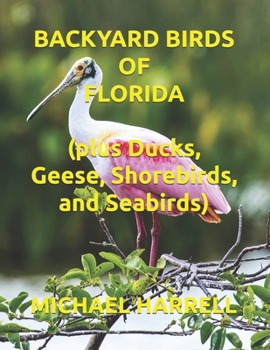
Backyard Birds of Florida
No Customer Reviews

Select Format
Select Condition 
Book Overview
Florida contains around 530 species of birds. Some of them are with us year round, and some visit us at certain times of the year. We won't try to cover them all, but we will look at some of the more familiar and interesting species. This book will cover most backyard birds seen in your yards, trees, bushes, at your feeders, and more. I wouldn't usually include wading birds, but they are so abundant in Florida that I have decided to do so. Some of these birds you will recognize immediately, and you may see them in your yard daily. Some will be seasonal visitors and may be birds you associate with particular times of the year. Some birds are signs of spring, and some are signs of winter. In this book, you will find great color pictures, detailed descriptions, information on sounds, diet, and more. I hope you will use this to identify the birds you see and enjoy those birds even more. Quick Identification Guide The quick identification guide has all of the backyard birds separated by color, size, and type. So, first you will find all of the birds categorized by their primary color. These colors include black, blue, brown, gray, green, orange, red, white, and yellow. For the birds with two primary colors, they will be found under both colors. For example, if a bird is mostly orange and black, it will be found under the orange and black categories. Also, males and females often look different. You may find the male of a species under one color group and the female in a different color group. Next, the birds are arranged from smallest to largest. This will also help with identification. Lastly, the birds are grouped by type. Under each color, all of the swallows are together, all woodpeckers are together, and so on. This will place similar birds side by side. In no time, you will quickly identify the birds you see. The first section of this book covered backyard birds. These birds are associated primarily with the land. Many birds live in close proximity to the water, and this water could be fresh or salt. The birds that are closely associated with water are found in this section. These water birds have been separated into three groups: (1) ducks, (2) geese, and lastly, (3) shorebirds and seabirds are grouped. Ducks (Group 1, page 218) have their own section, and so do geese (Group 2, page 228). Our third group (Group 3, page 229) of birds are the shorebirds and seabirds. These birds are much more associated with salt water, so they are separated into their own group. In the shorebird and seabird section, I have included: sandpipers, plovers, stilts, avocets, oystercatchers, gulls, terns, skimmers, pelicans, cormorants, gannets, tubenoses, and more. Most of these groups are found in this book.
Format:Paperback
Language:English
ISBN:B0CVH4T4KT
ISBN13:9798879310009
Release Date:February 2024
Publisher:Independently Published
Length:272 Pages
Weight:1.40 lbs.
Dimensions:0.6" x 8.5" x 11.0"
Related Subjects
NatureCustomer Reviews
0 rating
Copyright © 2026 Thriftbooks.com Terms of Use
| Privacy Policy | Do Not
Sell/Share My Personal Information | Cookie Policy | Cookie Preferences | Accessibility Statement
ThriftBooks® and the ThriftBooks® logo are registered trademarks of Thrift Books Global, LLC
ThriftBooks® and the ThriftBooks® logo are registered trademarks of Thrift Books Global, LLC
