


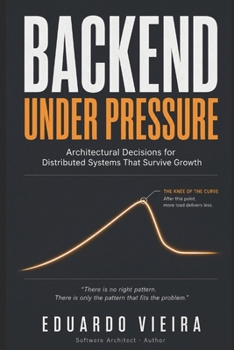
Backend Under Pressure: Architectural Decisions for Distributed Systems That Survive Growth

The servers were running at just 12% CPU-and still, no one could buy a ticket.
When Arena opens sales for a stadium concert, nearly one million people hit the platform at once. In seconds, connection pools are exhausted, transactions stall, seats are sold twice, and thousands of customers are charged without receiving a ticket.
The problem is not a lack of servers.
It is architecture.
Backend Under Pressure follows Arena's evolution across twenty-one chapters, showing how a backend grows from a stable monolith into a distributed system capable of surviving extreme demand. Every architectural decision is presented with its context, alternatives, trade-offs, consequences, and operational cost.
This is not a catalog of fashionable patterns. It is a practical guide to understanding when a solution fits the problem, when it should be rejected, and what complexity it introduces.
You will learn how to:
identify real bottlenecks before scaling the wrong layer;protect business invariants under high concurrency;decide between a modular monolith and microservices;shorten critical paths and remove external dependencies from transactions;apply messaging, Transactional Outbox, idempotency, and dead-letter queues;design sagas and compensation flows;use CQRS and Event Sourcing with clear business justification;work with caching, replicas, partitioning, and hot keys;implement admission control, virtual queues, backpressure, and graceful degradation;improve resilience with timeouts, retries, circuit breakers, and bulkheads;define SLIs, SLOs, error budgets, and meaningful alerts;validate architectural assumptions through load testing and controlled failure;document decisions through Architecture Decision Records.By the end of the book, you will be better prepared to defend technical decisions, avoid premature complexity, communicate trade-offs to business stakeholders, and design systems that can fail without turning every failure into a disaster.
Written for senior backend developers, tech leads, software architects, platform engineers, SREs, and engineering leaders who already know how to build systems-and now need to make them survive growth.
It wasn't that nothing went wrong. It was that what went wrong never became a disaster.
Customer Reviews
ThriftBooks ® and the ThriftBooks ® logo are registered trademarks of Thrift Books Global, LLC
