


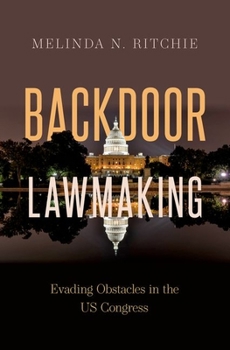
Backdoor Lawmaking: Evading Obstacles in the Us Congress
No Customer Reviews

Civics textbooks focus on how Congress makes policy through the legislative process, but the reality is that members of Congress have limited opportunities to advance their policy priorities. In fact, less than five percent of the bills that are introduced in Congress become law. Even the most tenacious legislators are confronted by bicameralism, partisan gridlock, chamber procedures, leadership's control of the agenda, and the diverse interests of 534 other members of Congress. What strategies do lawmakers have for navigating these challenges? In this book, Melinda N. Ritchie reveals how members of Congress use the federal bureaucracy as a backdoor for policymaking. Today, more law in the United States is made by unelected bureaucrats through federal agency regulations than with congressional statute. Ritchie argues that the bureaucracy's growing role in policymaking offers lawmakers a discreet way to represent controversial interests outside of the formal constraints of Congress. Lawmakers overcome obstacles in the legislative process by substituting agency regulations for legislation and pressuring agencies to make policy changes that would not pass Congress. Drawing on an original dataset constructed from records obtained under the Freedom of Information Act, Ritchie traces the interactions between members of Congress and federal agencies to illustrate how these communications function as part of a lawmaker's overarching strategy for policymaking. Original and timely, Backdoor Lawmaking explains how members of Congress exploit the separation of powers and evade the lawmaking process established in the US Constitution.
Format:Paperback
Language:English
ISBN:0197670490
ISBN13:9780197670491
Release Date:August 2023
Publisher:Oxford University Press
Length:272 Pages
Weight:0.10 lbs.
Dimensions:0.6" x 6.2" x 9.3"
Customer Reviews
0 rating
Copyright © 2026 Thriftbooks.com Terms of Use
| Privacy Policy | Do Not
Sell/Share My Personal Information | Cookie Policy | Cookie Preferences | Accessibility Statement
ThriftBooks® and the ThriftBooks® logo are registered trademarks of Thrift Books Global, LLC
ThriftBooks® and the ThriftBooks® logo are registered trademarks of Thrift Books Global, LLC
