


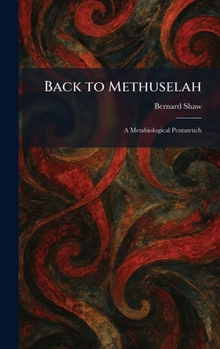
Back to Methuselah: A Metabiological Pentateuch

"Back to Methuselah. A Metabiological Pentateuch" is a monumental series of five plays by the celebrated dramatist Bernard Shaw, exploring the philosophical concept of Creative Evolution. Moving through vast stretches of time, the work begins in the Garden of Eden with Adam and Eve and concludes in a distant future where humanity has evolved beyond physical constraints. Shaw uses this ambitious framework to argue that the human lifespan is too short for individuals to gain the wisdom necessary for effective self-governance, suggesting that through the force of will, humanity must extend its life to hundreds of years.
Spanning from the dawn of creation to the year 31,920 AD, this "metabiological pentateuch" blends science fiction, satire, and social commentary. It stands as one of Shaw's most profound intellectual achievements, challenging readers and audiences to reconsider the potential of the human spirit and the biological destiny of the species. With its sharp wit and visionary scope, "Back to Methuselah" remains a significant contribution to early twentieth-century literature and a thought-provoking meditation on the intersection of biology and philosophy.
This work has been selected by scholars as being culturally important, and is part of the knowledge base of civilization as we know it. This work was reproduced from the original artifact, and remains as true to the original work as possible. Therefore, you may see the original copyright references, library stamps (as most of these works have been housed in our most important libraries around the world), and other notations in the work.
This work is in the public domain in the United States of America, and possibly other nations. Within the United States, you may freely copy and distribute this work, as no entity (individual or corporate) has a copyright on the body of the work.
As a reproduction of a historical artifact, this work may contain missing or blurred pages, poor pictures, errant marks, etc. Scholars believe, and we concur, that this work is important enough to be preserved, reproduced, and made generally available to the public. We appreciate your support of the preservation process, and thank you for being an important part of keeping this knowledge alive and relevant.
Customer Reviews
ThriftBooks® and the ThriftBooks® logo are registered trademarks of Thrift Books Global, LLC
