


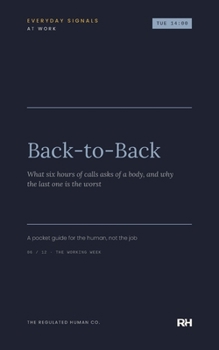
Back-to-Back

Six calls. No gaps. By the last one you are not in the room.
Nobody designed the day. It filled itself, one accepted invitation at a time, and every one of them was reasonable.
Each call is fine. Six in a row is not, because a body does not get to finish one thing before the next begins, and unfinished things stack in the shoulders.
By two o'clock you are answering in flat sentences. By five to five you snap at something small.
A short book about the stack.
What is in it:
What a day without edges does to attention, and why the sixth call is the worst whatever is in it.
The four ways it shows: the flat sentence, the headache behind the eyes, the hunger you did not notice, and the snap at five to five.
Six things that make it heavier. Running over. Eating at the desk with the camera off. Putting the hard one last. Leaving the camera always on. Not moving since eight. And "just a quick one" in the only gap you had.
Four minutes between calls, written into the diary so they exist. Twenty minutes of gaps across a whole day is the entire difference.
Water, window, then the next - and not the inbox, which is a seventh call in a different costume.
Saying the end time at the start, in the first minute, which is the one sentence that reliably buys the gap back.
Breathing out and dropping the shoulders as each call ends, so the ending is a thing the body notices.
Eating away from the screen, even for ten minutes.
One call a day on the phone, walking. Camera off for one. The hard one before lunch rather than last.
Two minutes standing before the last call, and saying what it is when you arrive late to yourself.
Noticing the day that had edges, so the body learns the difference is real.
What to do when the calls are all on a screen, when you are the one everybody needs in the room, when there genuinely is no gap, and when the last call is the one that matters.
And the part nobody tells you: the stack is not weak stamina, and the people who seem fine at five were not built differently. Nobody's body was built for this.
There is nothing here about having fewer meetings, or about how meetings ought to be run.
The aim is a body that arrives at each one, rather than carrying the last five in.
"Four minutes. Water. Window. Then the next."
For the human, not the job. Sixty-four pages, small enough for a coat pocket.
This book supports everyday emotional awareness. It is not a screening tool and it is not a substitute for professional guidance.
Everyday Signals at Work: short guides for the hard bits of an ordinary working day. No quick fixes. No hype. Regulation before optimisation.
Customer Reviews
ThriftBooks ® and the ThriftBooks ® logo are registered trademarks of Thrift Books Global, LLC
