


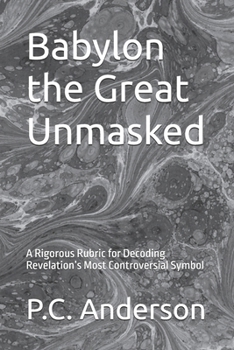
Babylon the Great Unmasked: A Rigorous Rubric for Decoding Revelation’s Most Controversial Symbol

What if the mystery of Babylon the Great isn't solved by choosing one interpretation-but by evaluating them all with disciplined, transparent criteria?
Babylon the Great Unmasked offers a groundbreaking, methodical approach to one of Scripture's most debated figures. Rather than forcing Revelation 17-18 into a single historical, symbolic, or futurist box, this book constructs a ten-variable interpretive rubric that tests eight major hypotheses across three layers of meaning: - Historical Anchor (What would John's first-century readers have understood?) - Symbolic Pattern (How does Babylon function as a recurring archetype?) - Eschatological Projection (How might the symbol culminate in the future?)
Drawing deeply from Revelation's Old Testament foundations-Isaiah, Jeremiah, Ezekiel, and even Babel itself-the book demonstrates that Babylon the Great is one of the most densely layered symbols in the biblical canon. She is portrayed as a woman, a city, an economic empire, a religious seductress, and a persecuting power. Any interpretation that flattens this complexity inevitably fails the text.
Across chapters devoted to intertextual continuity, first-century plausibility, symbolic density, textual specificity, theological coherence, recurrence, explanatory scope, and more, each hypothesis is scored on a 1-5 scale. The contenders include:
- Historical Rome - Jerusalem as the apostate covenant community - Economic-commercial system - Cultic/religious system - Eschatological future world-city - Pure symbolic/mythic corruption - Future/Revived Rome (Papal/Vatican) - Composite "World City" Archetype
The results are striking. When tested against the full biblical data, the Composite "World City" Archetype emerges as the most robust and textually faithful model-scoring 46/50. This view honors Rome as the immediate referent for John's audience while recognizing Babylon as a recurring pattern of human imperial-religious rebellion that appears throughout history and will culminate in a final eschatological form. As the manuscript notes, Revelation's Babylon "stands in a long biblical line of proud, seductive, bloodguilty cities and empires," a pattern that stretches from Babel to Rome and beyond.
Far from being a compromise, this layered approach reveals the intentional richness of apocalyptic literature. It explains why Babylon can be Rome for the first century, a warning for every age, and a prophecy of the final anti-kingdom that God will overthrow in a single hour. It also clarifies the profound contrast between the harlot Babylon and the Bride of the Lamb-one doomed to fiery judgment, the other destined for eternal glory.
Complete with comparative tables, detailed scoring, and an appendix showing independent validation of the rubric by multiple AI evaluators, Babylon the Great Unmasked equips readers with a clear, reproducible method for interpreting one of Revelation's most complex symbols. It is ideal for pastors, scholars, students, and serious readers seeking a balanced, text-driven, and theologically coherent understanding of Babylon the Great.
Babylon will fall. The Bride will shine forever.
Customer Reviews
ThriftBooks ® and the ThriftBooks ® logo are registered trademarks of Thrift Books Global, LLC
