


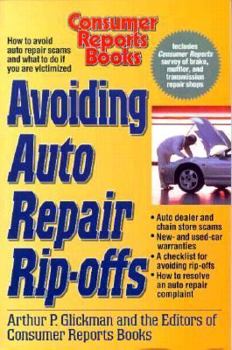
Avoiding Auto Repair Rip-Offs


Select Format
Select Condition 
Book Overview
Americans spend an estimated $110 billion a year on auto repair. And surveys show that the chances of having a car repaired without being cheated are high. This helpful, informative guide will help... This description may be from another edition of this product.
Format:Paperback
Language:English
ISBN:0890437610
ISBN13:9780890437612
Release Date:January 1995
Publisher:Consumer Reports Books
Length:198 Pages
Weight:0.60 lbs.
Dimensions:9.3" x 0.8" x 5.8"
Customer Reviews
1 rating
Essays on Auto Repairs
Published by Thriftbooks.com User , 19 years ago
'Consumers Reports' are aimed at a person who has little knowledge about an item they intend to buy, and cannot do research on their own. They do trust CR as it provides an oversight that is lacking in other magazines which are supported by their advertisers. What good does that do for you? It depends. You will get a sense that others have done the research and testing. But I would recommend doing your own research and using CR to test your efforts. The 'Introduction' betrays its attitude ("you're going to be cheated") which can become a self-fulfilling prophecy. They quote a TV host who is no more likely to go to an auto repair shop than mow the lawn on his estate (p.1). To find a good mechanic, ask your neighbors and co-workers. You are the final judge. I've used a new car dealer, independent shops, and a local chain. I had distasteful results from a nationally advertised franchise chain; they have to charge more for their franchise costs. Any independent shop survives by doing a good job at a good price, not by advertising on TV. Isn't this like your selection of a doctor, dentist, or other professionals? Having a license does not guarantee your satisfaction. This book lacks a chart giving the estimated time and mileage needed for parts replacement. The Operator's Manual does not cover all items. Automobiles are the most complex mechanical item you own. It stands outside in all weather and operates over bumpy roads at high speeds. It won't last forever with normal use. There is a problem in replacement parts when the car is over 14 years old. I once heard a retired auto mechanic say most mechanics are honest. But if you appear ignorant about cars, some will treat you as a sheep to be shorn. You might have heard this about other businesses. Some of the examples in this book may be misleading. 'MOTOR' magazine has stories of customers who come in with a vague description of a problem and a mechanic has to spend extra time to diagnose the problem. Sometimes fixing one problem reveals another. [I once knew of a person whose car was hard to start. She burnt out the starter and killed the battery. The cause was an "automatic choke" that didn't work right. A $20 part resulted in over $300 in repairs (1979 prices).] Do not overlook a problem, write down its description as you experience it. A problem that only happens when the car is cold or hot is more difficult to diagnose and fix correctly. Some mechanics will suggest needed work, but customers hate to hear this. Many small new car dealers have gone out of business since the 1980s. Bigger isn't always better; look for experienced mechanics who can explain the problem. Unless you have a problem in a strange town, your proper behavior should avoid horror stories. Make your own luck. Don't expect something for nothing. I would recommend any Adult Educational Course that will teach you about your car.
Copyright © 2026 Thriftbooks.com
Terms of Use | Privacy Policy | Do Not Sell/Share My Personal Information | Cookie Policy | Cookie Preferences | Accessibility Statement
ThriftBooks ® and the ThriftBooks ® logo are registered trademarks of Thrift Books Global, LLC
ThriftBooks ® and the ThriftBooks ® logo are registered trademarks of Thrift Books Global, LLC
