


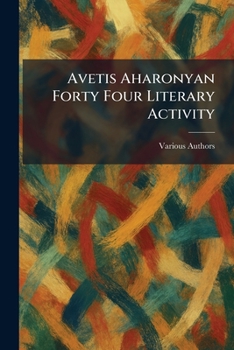
Avetis Aharonyan Forty Four Literary Activity

"Avetis Aharonyan Forty Four Literary Activity 1890-1930" offers a comprehensive examination of the life and work of one of the most significant figures in Armenian cultural history. Spanning forty-four years of creative output, this volume delves into the literary career of Avetis Aharonyan, whose writings became a voice for the Armenian spirit during a period of immense national transition and trauma. From his early depictions of village life to his later works reflecting the complexities of political leadership and exile, the book documents the evolution of a writer who masterfully bridged the gap between literature and revolutionary thought.
This collection serves as an essential guide to Aharonyan's diverse bibliography, encompassing short stories, prose poems, and essays that defined the Armenian aesthetic in the late 19th and early 20th centuries. By analyzing the thematic depth and stylistic innovations of his work, the text provides readers with a profound understanding of how Aharonyan utilized the power of the written word to advocate for social justice and national self-determination. It is an invaluable resource for those interested in Armenian studies, comparative literature, and the historical intersections of art and statecraft.
This work has been selected by scholars as being culturally important, and is part of the knowledge base of civilization as we know it. This work was reproduced from the original artifact, and remains as true to the original work as possible. Therefore, you may see the original copyright references, library stamps (as most of these works have been housed in our most important libraries around the world), and other notations in the work.
This work is in the public domain in the United States of America, and possibly other nations. Within the United States, you may freely copy and distribute this work, as no entity (individual or corporate) has a copyright on the body of the work.
As a reproduction of a historical artifact, this work may contain missing or blurred pages, poor pictures, errant marks, etc. Scholars believe, and we concur, that this work is important enough to be preserved, reproduced, and made generally available to the public. We appreciate your support of the preservation process, and thank you for being an important part of keeping this knowledge alive and relevant.
Customer Reviews
ThriftBooks ® and the ThriftBooks ® logo are registered trademarks of Thrift Books Global, LLC
