


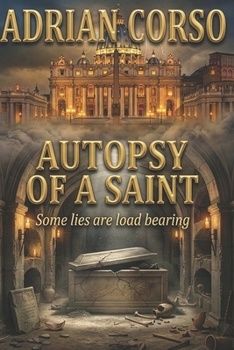
Autopsy of a Saint
No Customer Reviews

The blood of San Gennaro refused to liquefy, and three people died because of what Dr. Aris Thorne knew.
Six years ago, forensic pathologist Aris Thorne proved that Naples' most sacred relic was medieval chemistry. He exposed the fraud at a press conference. The riot that followed killed a grandmother in a blue dress, a woman who died in his arms, still whispering about the miracle that had abandoned her. He burned the report. He rebuilt his life around a single rule: truth is a tool. Use it wrong, and people die. Now the Vatican is calling again. Beneath Rome, a sealed fourth-century tomb has been opened during routine excavation. Inside: a skeleton kneeling in prayer, held in position by copper wire threaded through drilled holes in the bones. Engineering disguised as divine preservation. A manufactured saint. But the tomb was pressurized. And when the seal cracked, the air smelled of ozone, a chemical that cannot survive seventeen centuries in a sealed chamber. Something inside is still active. Something that shouldn't be possible. Thorne is hired to explain the science. Vatican archivist Dr. Isabella Conti is assigned to manage the institution's exposure. She has her own reasons for wanting the truth. Reasons that trace back to a brother silenced by the Church, a settlement that bought her family's cooperation, and a suicide note that was three sentences long. What they uncover is bigger than one fraudulent saint. Hidden beneath the skeleton's tomb, a seventh-century confession has been scraped away and overwritten, a palimpsest preserving seventeen centuries of institutional knowledge that the miracle was manufactured. Exposed, it wouldn't just discredit one relic. It would crack the foundation beneath 1.2 million devotees, 47 million euros in annual pilgrimage revenue, and hundreds of schools and hospitals sustained by faith in a saint who never performed a single miracle. The Vatican calls it a load-bearing lie. Remove it, and everything built on top collapses. Thorne and Conti call it evidence. Now they're running. From Vatican operatives authorized to use permanent measures. From brokers offering millions for their silence. And from the impossible question neither of them can answer: Does the world need this truth? Or will it simply create new victims? A fugitive chase from Rome to Avignon. A seven-hundred-year-old document that could reshape two billion people's faith. A dead man's switch counting down to forced disclosure. And two people who must decide whether managed revelation is wisdom, or just another form of institutional cover-up. Autopsy of a Saint is a literary thriller about the archaeology of lies, the engineering of belief, and what happens when the people paid to protect an institution decide to hold it accountable instead. For readers of The Name of the Rose, Conclave, and The Da Vinci Code. But darker, sharper, and asking questions those books never dared.Format:Paperback
Language:English
ISBN:B0GM5CBWYK
ISBN13:9798247197607
Release Date:February 2026
Publisher:Independently Published
Length:308 Pages
Weight:0.91 lbs.
Dimensions:0.7" x 6.0" x 9.0"
Customer Reviews
0 rating
Copyright © 2026 Thriftbooks.com Terms of Use
| Privacy Policy | Do Not
Sell/Share My Personal Information | Cookie Policy | Cookie Preferences | Accessibility Statement
ThriftBooks® and the ThriftBooks® logo are registered trademarks of Thrift Books Global, LLC
ThriftBooks® and the ThriftBooks® logo are registered trademarks of Thrift Books Global, LLC
