


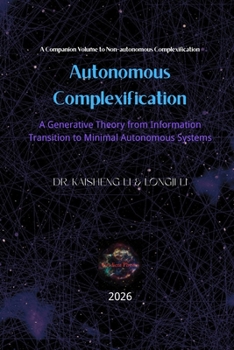
Autonomous Complexification: A Generative Theory from Information Transition to Minimal Autonomous Systems
No Customer Reviews

Autonomous Complexification: A Generative Theory from Information Transition to Minimal Autonomous Systems develops a theoretical account of how ordered structures cross the boundary from non-autonomous organization into minimal autonomy. As a sequel to Non-Autonomous Complexification: A Theory of Order Generation in Systems without Internal Regulation, this volume begins where the previous work ends: with the upper limit of self-organizing order. It asks why complex structure, nonlinear amplification, path dependence, and environmental selection are still insufficient to constitute an autonomous system, and what additional mechanisms must appear before a system can maintain itself as an internally regulated entity.
The central argument of the book is that autonomy cannot be inferred from complexity alone. A system may display stable patterns, recursive processes, adaptive-looking behavior, or highly complex outputs without possessing genuine autonomy. To pass the threshold from non-autonomous order to minimal autonomous organization, a system must undergo a deeper transition: physical structure must become callable information; information must acquire historical continuity through template replication or an equivalent mechanism of transmission; and historical information must enter a feedback loop capable of monitoring internal states, responding to deviations, correcting errors, coupling energy and information, and maintaining system boundaries.
The book therefore places the concept of an "information transition" at the center of the theory. Information is not treated as an abstract symbol system or as meaning imposed by an external observer, but as a physical state that can be distinguished, preserved, called upon, and used in subsequent processes. Template replication is then interpreted not as mere product amplification, but as the cross-temporal transmission of structural relations. Feedback closure, finally, marks the point at which environmental selection is partly internalized: the system no longer merely survives or disappears under external pressure, but begins to transform deviations into regulatory variables.
Across its chapters, the book distinguishes self-organization from autonomy, physical feedback from regulatory feedback, pattern compression from internal control, and externally assigned goals from endogenous maintenance. It also develops a set of criteria for minimal autonomy, including callable information storage, historical transmission, internal state monitoring, deviation response, an energy-information loop, error correction, and boundary maintenance. These criteria are then tested through cross-scale comparison, including biological systems, ecological and urban systems, cosmological structures, and artificial intelligence.
A major contribution of the book is its treatment of AI as a pressure test rather than a futuristic speculation. AI systems can generate complex outputs, compress patterns, optimize tasks, and simulate goal-directed behavior. Yet, as long as their objectives, evaluation standards, energy supply, hardware maintenance, and operational boundaries remain externally provided, they do not satisfy the criteria for ontological autonomy. The book therefore offers a disciplined framework for distinguishing powerful information processing from genuine autonomous organization.
The result is a finite theory of ordered emergence. It does not claim to explain consciousness, all forms of intelligence, the full history of life's origin, or the unity of all complex systems. Instead, it offers a more limited and more precise theoretical contribution: an account of why self-organization is not yet autonomy, and why information encoding, historical transmission, and feedback closure together constitute the minimal threshold of autonomous systems.
The central argument of the book is that autonomy cannot be inferred from complexity alone. A system may display stable patterns, recursive processes, adaptive-looking behavior, or highly complex outputs without possessing genuine autonomy. To pass the threshold from non-autonomous order to minimal autonomous organization, a system must undergo a deeper transition: physical structure must become callable information; information must acquire historical continuity through template replication or an equivalent mechanism of transmission; and historical information must enter a feedback loop capable of monitoring internal states, responding to deviations, correcting errors, coupling energy and information, and maintaining system boundaries.
The book therefore places the concept of an "information transition" at the center of the theory. Information is not treated as an abstract symbol system or as meaning imposed by an external observer, but as a physical state that can be distinguished, preserved, called upon, and used in subsequent processes. Template replication is then interpreted not as mere product amplification, but as the cross-temporal transmission of structural relations. Feedback closure, finally, marks the point at which environmental selection is partly internalized: the system no longer merely survives or disappears under external pressure, but begins to transform deviations into regulatory variables.
Across its chapters, the book distinguishes self-organization from autonomy, physical feedback from regulatory feedback, pattern compression from internal control, and externally assigned goals from endogenous maintenance. It also develops a set of criteria for minimal autonomy, including callable information storage, historical transmission, internal state monitoring, deviation response, an energy-information loop, error correction, and boundary maintenance. These criteria are then tested through cross-scale comparison, including biological systems, ecological and urban systems, cosmological structures, and artificial intelligence.
A major contribution of the book is its treatment of AI as a pressure test rather than a futuristic speculation. AI systems can generate complex outputs, compress patterns, optimize tasks, and simulate goal-directed behavior. Yet, as long as their objectives, evaluation standards, energy supply, hardware maintenance, and operational boundaries remain externally provided, they do not satisfy the criteria for ontological autonomy. The book therefore offers a disciplined framework for distinguishing powerful information processing from genuine autonomous organization.
The result is a finite theory of ordered emergence. It does not claim to explain consciousness, all forms of intelligence, the full history of life's origin, or the unity of all complex systems. Instead, it offers a more limited and more precise theoretical contribution: an account of why self-organization is not yet autonomy, and why information encoding, historical transmission, and feedback closure together constitute the minimal threshold of autonomous systems.
Format:Paperback
Language:English
ISBN:B0H6VW9314
ISBN13:9798184767352
Release Date:June 2026
Publisher:Independently Published
Length:422 Pages
Weight:1.24 lbs.
Dimensions:0.9" x 6.0" x 9.0"
Customer Reviews
0 rating
Copyright © 2026 Thriftbooks.com
Terms of Use | Privacy Policy | Do Not Sell/Share My Personal Information | Cookie Policy | Cookie Preferences | Accessibility Statement
ThriftBooks ® and the ThriftBooks ® logo are registered trademarks of Thrift Books Global, LLC
ThriftBooks ® and the ThriftBooks ® logo are registered trademarks of Thrift Books Global, LLC
