


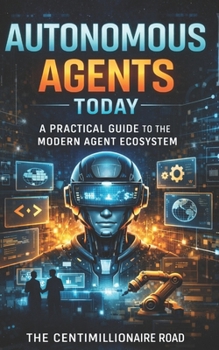
Autonomous Agents Today: A Practical and Complete Manual of the Existing Agent Ecosystem

A Practical and Complete Manual of the Existing Agent Ecosystem
Artificial intelligence agents are no longer experimental concepts confined to research labs. They are already operational systems capable of performing real work: researching information, generating software, analyzing markets, interacting with tools, and coordinating complex workflows.
This book explains how that ecosystem actually works today.
Rather than speculating about distant futures or artificial general intelligence, Autonomous Agents Today focuses on real technologies that can be deployed now. It provides a clear architectural understanding of how modern agent systems are built, what tools power them, and how individuals and developers can assemble their own autonomous infrastructures.
Autonomous Agents Today
Inside this manual you will learn:
What an autonomous agent really is and how it differs from simple automation
The agent stack architecture: models, memory systems, planning layers, tools, and orchestration
The current ecosystem of frameworks used by developers
How major LLM providers power agent systems
The role of vector databases and retrieval systems
How agents interact with APIs, browsers, and execution environments
How to build single-agent and multi-agent systems step by step
Real-world applications already deployed today
The limitations, costs, and failure modes of current agents
How to design your own autonomous agent architecture from first principles
The book covers the complete landscape of modern agent development, including:
LangChain and LangGraph
Crew-based multi-agent architectures
Experimental autonomous frameworks
Lightweight custom agent systems
No-code and low-code agent builders
Hosted AI platforms and infrastructure tools
This is not a theoretical introduction. It is a practical systems manual designed to help you understand the mechanics behind agentic AI and move from casual usage to architectural mastery.
By the end of the book, you will understand how autonomous systems are constructed, how the components interact, and how to design infrastructures that operate continuously and reliably.
Autonomy is not magic.
It is architecture.
And once you understand the architecture, you can build the system.
Customer Reviews
ThriftBooks ® and the ThriftBooks ® logo are registered trademarks of Thrift Books Global, LLC
