


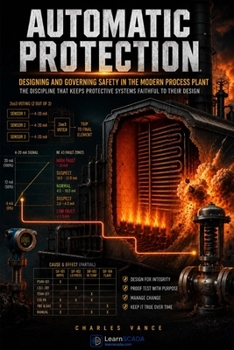
Automatic Protection: Designing and Governing Safety in the Modern Process Plant

Automatic Protection is the answer to that question - and to the hundred others like it that quietly decide whether a protective system actually protects.
Written for the engineers who build and maintain protective systems in Ignition and Rockwell, this is a working field guide to getting automatic protection right. It starts from first principles - what bad quality really means, why fail-safe is a design choice, how a cause-and-effect matrix becomes the law of the plant - then moves through voting architectures, SIL, and LOPA, and into the controller logic, the HMI annunciation, and the forensic record that proves what happened after a trip. It closes with the operations discipline that keeps protection sound for decades: bypasses and overrides, alarm floods, proof testing, and management of change.
One argument runs through every chapter: the conflict between safety and availability is almost always an artifact of a single transmitter, and the fix is architecture, not amputation. When a trip is costly, you buy back availability with redundancy and good design - you do not quietly remove a layer of protection and hope.
Inside this bookBad quality, fail-safe, and the integrity of the signalCause-and-effect matrices as the design authorityVoting architectures: from 1oo1 to 2oo3SIS vs. BPCS, SIL, and layer-of-protection analysisProtective logic in Rockwell; alarming and annunciation in IgnitionFirst-out, sequence of events, and post-trip forensicsBypasses, proof testing, and management of changePlainspoken, standards-aware (ISA 18.2, IEC 61511, NAMUR), and built on real plant experience, it is the book to hand the new engineer - and the one to keep beside the keyboard when the pressure is on to take a shortcut.
Customer Reviews
ThriftBooks ® and the ThriftBooks ® logo are registered trademarks of Thrift Books Global, LLC
