


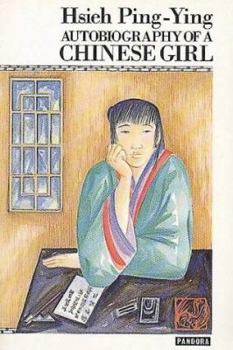
Autobiography of a Chinese Girl


No Synopsis Available.
Format:Paperback
Language:English
ISBN:0863580521
ISBN13:9780863580529
Release Date:January 1986
Publisher:Pandora Pr
Length:216 Pages
Weight:0.40 lbs.
Customer Reviews
1 rating
A look back on history in the making
Published by Thriftbooks.com User , 25 years ago
The Autobiography of a Chinese Girl is a translation of the memoirs of a young girl in China during the first half of the 20th century. Min Kon, who later changed her name to Hsieh Ping-Ying, wrote a first-hand memoir of her experiences in her youth. She also wrote other versions of her memoirs emphasizing different parts of her life. Her autobiography is written in the form of a coherent narrative, separated into five parts following the major stages of her life. Each part if divided into several chapters to clearly outline the major events and influences in her life. This coherent narrative is approximately 216 pages long and covers her early childhood through her schooling, her army life, her imprisonment at home, and then her pursuit of a freedom. In this vivid tale, we follow the development of the personality of resistance to the traditional Chinese culture in the early part of the 20th century. The story starts with Min Kon's childhood in a small village where she is confined to the life of a girl in traditional Chinese society at a time when many of these traditions, such as arranged marriage and footbinding, were already becoming outdated. Her rebel spirit is evident in her actions as a child and her modern ideas shine through in her desire to break the traditional mold. After resisting the pressures of her family, she is allowed to attend school. Despite her brilliant academic record, Min Kon often finds herself leading student movements. Her behavior causes her to change schools frequently until she quits to join the revolutionary communist army in 1926. Min Kon joins a military school where she is immediately expelled and rejoins under the new name of Hsieh Ping-Ying. In this autobiography, the themes of rebellion and resistance are most prominent. Hsieh Ping-Ying demonstrates her rebellious spirit through her endless pursuit of freedom from traditional Chinese culture and the place in society imposed upon her. She is not willing to conform or watch history be made. She not only incessantly resists her parents wishes, but also rebels against the politics and oppression of the people of China at that time. Not only does she fight for her own sense of equality, but also that of the entire population. Min Kon is a symbol of the oppression of women of her generation and those who came before her. Although she was more fortunate than most, her plight is representative of her period, while painting a picture of the political movements which took place. In this dynamic, touching story, she demonstrates the personal desire, motivation, and persistence needed to achieve her dream of freedom. This book is an excellent example of the transitional and unstable culture and politics of the time. Written through the eyes of a young girl from the country limits the scope of the story, but allows the reader to grasp how Chinese culture was transforming as history was taking place through a clear, yet limited view. This story is both captivatin
Copyright © 2026 Thriftbooks.com Terms of Use
| Privacy Policy | Do Not
Sell/Share My Personal Information | Cookie Policy | Cookie Preferences | Accessibility Statement
ThriftBooks® and the ThriftBooks® logo are registered trademarks of Thrift Books Global, LLC
ThriftBooks® and the ThriftBooks® logo are registered trademarks of Thrift Books Global, LLC
