


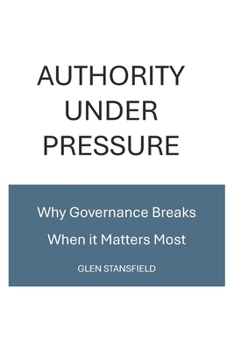
Authority Under Pressure: Why Governance Breaks When It Matters Most

Your governance model may work perfectly - until the organisation actually needs to make a difficult decision.
During major incidents, outages, crises and high-pressure operational events, organisations rarely discover that they have no governance.
They discover something more dangerous.
The governance exists, but the authority to act has become unclear, fragmented or too slow to use.
Authority Under Pressure examines why this happens.
It explores the gap between governance as designed and governance as experienced when time is limited, information is incomplete, consequences are real and somebody must decide what happens next.
The central question is simple:
When pressure increases, does your organisation still know who has the authority to decide?
This book examines how:
- decision authority becomes fragmented across teams and leadership layers;
- escalation creates delay instead of resolving uncertainty;
- accountability can exist on paper without usable authority in practice;
- governance designed for stable conditions behaves differently under operational stress;
- evidence, ownership and decision rights interact when certainty is impossible; and
- organisations can design governance that remains usable when the cost of delay is increasing.
Rather than treating governance as a collection of policies, committees and approval structures, Authority Under Pressure examines it as an operational capability.
Because the real test of governance is not whether responsibilities have been documented.
It is whether the organisation can still make a defensible decision when the answer is uncertain, the clock is running and the consequences belong to someone.
Who this book is forWritten for senior leaders, Service Owners, technology and operations leaders, risk and governance professionals, incident and crisis managers, resilience practitioners, and anyone responsible for decisions during consequential operational events.
If you have watched an incident escalate while everyone waited for somebody else to authorise the next move, this book addresses the governance problem behind that experience.
Governance is rarely tested when the answer is obvious.
It is tested when somebody has to decide before certainty arrives.
This book discusses governance and organisational decision-making practices. It does not provide legal advice.
Customer Reviews
ThriftBooks ® and the ThriftBooks ® logo are registered trademarks of Thrift Books Global, LLC
