


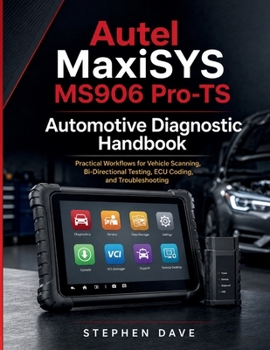
Autel MaxiSYS MS906 Pro-TS Automotive Diagnostic Handbook: Practical Workflows for Vehicle Scanning, Bi-Directional Testing, ECU Coding, and Troublesh

A professional scan tool becomes valuable only when its results are combined with sound diagnostic reasoning. A trouble code is evidence, not proof that a component has failed. A live-data value requires operating context, an active test must answer a defined question, and a successful message on the screen still requires verification on the vehicle.
This handbook develops a repeatable diagnostic process for the Autel MaxiSYS MS906 Pro-TS, beginning with correct vehicle identification and stable module communication before progressing to evidence capture, test selection, repair confirmation and documentation.
The opening chapters explain tablet setup, registration, network connections, software updates, vehicle communication, interface navigation, automatic and manual identification, system scans, module topology and connection failures. Readers learn how to distinguish a scan-tool problem from a fault in the vehicle network, power supply, diagnostic connector or control module.
The diagnostic chapters show how to interpret trouble codes and freeze-frame information, select useful data parameters, compare related signals, graph changing values and capture intermittent events. Bidirectional controls are presented as structured diagnostic tests rather than demonstrations of tool capability.
Readers learn to combine scan results with wiring diagrams, circuit measurements, mechanical checks, service information, vehicle history and known operating conditions before replacing parts. This evidence-based approach helps prevent unnecessary repairs caused by treating codes or individual data values as final conclusions.
Service and configuration coverage includes maintenance resets, brake and steering procedures, chassis functions, powertrain operations, adaptations, relearns, coding and guided functions. The book explains prerequisites, battery-voltage requirements, access restrictions, software limitations and the importance of confirming whether a function is supported for the specific vehicle.
A dedicated tire-pressure monitoring section follows TPMS work from sensor activation and identification through programming, relearn procedures, difficult faults, replacement questions and post-service confirmation.
Later chapters address battery and charging analysis, driver-assistance system boundaries, diagnostic reports, stored records, vehicle history, technical support, software coverage, optional measurement accessories, recovery procedures and dependable workshop maintenance. High-consequence operations are accompanied by decision guidance that helps technicians recognize when the required equipment, authorization, service information or training is unavailable.
Readers will learn how to:
Establish reliable identification and control-module communicationInterpret trouble codes, freeze frames and related live-data signalsUse graphs and recordings to capture intermittent conditionsApply actuator commands to isolate circuit and operating faultsPrepare resets, adaptations, relearns and configuration functionsActivate, program and relearn tire-pressure monitoring sensorsPreserve evidence and document verified repairsConfirm post-repair operation before releasing the vehicleWritten for technicians, workshop owners, automotive students and experienced users, this independent technical guide moves beyond menu exploration toward controlled diagnosis and repeatable workshop practice.
Customer Reviews
ThriftBooks ® and the ThriftBooks ® logo are registered trademarks of Thrift Books Global, LLC
