


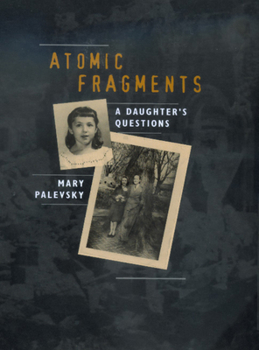
Atomic Fragments: A Daughter's Questions

More than most of us, Mary Palevsky needed to come to terms with the moral complexities of the atomic bomb: Her parents worked on its development during World War II and were profoundly changed by that experience. After they died, unanswered questions sent their daughter on a search for understanding. This compelling, sometimes heart-wrenching chronicle is the story of that quest. It takes her, and us, on a journey into the minds, memories, and emotions of the bomb builders.
Scientists Hans Bethe, Edward Teller, Joseph Rotblat, Herbert York, Philip Morrison, and Robert Wilson, and philosopher David Hawkins responded to Palevsky's personal approach in a way that dramatically expands their previously published statements. Her skill and passion as an interlocutor prompt these men to recall their lives vividly and to reexamine their own decisions, debating within themselves the complex issues raised by the bomb.
The author herself, seeking to comprehend the widely differing ways in which individual scientists made choices about the bomb and made sense of their work, deeply reconsiders those questions of commitment and conscience her parents faced. In personal vignettes that complement the interviews, she captures other remembrances of the bomb through commemorative events and chance encounters with people who were "there." Her concluding chapter reframes the crucial moral questions in terms that show the questions themselves to be the abiding legacy we all share. This beautifully written book bridges generations to make its readers participants in the ongoing dialogue about science and philosophy, war and peace.
Scientists Hans Bethe, Edward Teller, Joseph Rotblat, Herbert York, Philip Morrison, and Robert Wilson, and philosopher David Hawkins responded to Palevsky's personal approach in a way that dramatically expands their previously published statements. Her skill and passion as an interlocutor prompt these men to recall their lives vividly and to reexamine their own decisions, debating within themselves the complex issues raised by the bomb.
The author herself, seeking to comprehend the widely differing ways in which individual scientists made choices about the bomb and made sense of their work, deeply reconsiders those questions of commitment and conscience her parents faced. In personal vignettes that complement the interviews, she captures other remembrances of the bomb through commemorative events and chance encounters with people who were "there." Her concluding chapter reframes the crucial moral questions in terms that show the questions themselves to be the abiding legacy we all share. This beautifully written book bridges generations to make its readers participants in the ongoing dialogue about science and philosophy, war and peace.
Format:Hardcover
Language:English
ISBN:0520220552
ISBN13:9780520220553
Release Date:May 2000
Publisher:University of California Press
Length:303 Pages
Weight:1.42 lbs.
Dimensions:1.0" x 6.3" x 9.3"
Customer Reviews
3 ratings
Moving example of fine qualitative research
Published by Thriftbooks.com User , 25 years ago
Born just after the war ended, I always wondered how "we" could have dropped those awful bombs on Japan. Later, as a social scientist myself, with a particular interest in moral quandaries, the whole issue of the rightness or wrongness of the decision has fascinated me. Now, for the first time, Palevsky's ATOMIC FRAGMENTS takes on this issue in a human, compelling, heartfelt manner. After the death of her much-loved father, who was involved in the science of that era and who spent much effort later on to ensure such horrors would never again need to be unleashed, Palevsky was drawn to interview many of the physicists, now aging, who were directly responsible for those bombs. She magnificently intersperses her questions, their responses, and her impressions -- allowing readers to feel as though we were there too. I especially appreciate the lack of easy conclusions. In the best tradition of qualitative research, Palevsky asks, reports, wonders, considers -- and leaves the unanswerable unanswered.
Atomic Fragments, A Daughter's Questions
Published by Thriftbooks.com User , 25 years ago
Atomic Fragments, A Daughter's Questions, is a stunning book, beautifully written, dealing with the tough moral questions that arose after the atomic bomb was built and dropped on Hiroshima and Nagasaki in 1945. Mary Palevsky, daughter of two scientists who worked at Los Alamos, knows first-hand how profoundly their lives were changed by their roles as "bomb builders". Her father, appalled by the use of the bomb, never again worked on any type of weapons research or development. Her mother gave up her science career.Mr. Palevsky worked for more than thirty years as an experimental nuclear physicist at the Brookhaven National Laboratory on Long Island, retiring in 1981, after a series of strokes. Throughout his life he had deep misgivings about the use of the bomb and his participation in its creation. In his waning days, he spent long hours talking with Mary about his life and work and philosophical conflicts.After his death, Mary took on the task of addressing these moral complexities through a series of interviews with seven of the key figures in atomic history: Hans Bethe, Edward Teller, Joseph Rotblat, Philip Morrison, Robert Wilson, Herbert York and the philosopher, David Hawkins. Atomic Fragments is a record of those interviews, her quest to understand her late parents and the forces that shaped their lives...and hers. Her interviewing style is penetrating, yet not intrusive, giving each man an opportunity to rethink his own views on these monumental issues. The author's accompanying text and personal vignettes weave a thoughtful story of the remarkable circumstances surrounding one of the watershed events of the twentieth century.Mary Palevsky has written a brilliant book which forces the reader to confront some of the major ethical issues of our time: scientific research, nuclear weapon decision-making, and public policy formation. It is a "must read" for thoughtful people of all generations.
Another Look Back
Published by Thriftbooks.com User , 25 years ago
In 1994, Mary Palevsky embarked on a personal quest, and with the publication of ATOMIC FRAGMENTS: A DAUGHTER'S QUESTIONS, we have all become the recipients of its outcome. What she sought was to understand the people and the times that had created the first atomic bomb and ushered in the nuclear age. Palevsky's parents worked in Los Alamos on the Manhattan Project during the last years of World War II. Their efforts in the development of the atomic bomb helped to bring the war to an end, yet in later years they expressed regrets at having contributed to the creation of such a terrible weapon. Her father especially struggled at the end of his life to "reconcile the moral complexities of the bomb." After the deaths of her parents, their questions became a large part of Palevsky's legacy. She wondered if the other Manhattan Project scientists had misgivings, so she contacted and interviewed team members still living, among them Hans Bethe, Edward Teller, Philip Morrison, Joseph Rotblat, David Hawkins, Robert Wilson, and Herbert York. What she learned surprised her. Almost all of them still believed that they did the right thing. ATOMIC FRAGMENTS: A DAUGHTER'S QUESTIONS is the result of Palevsky's verbal journeys with these men, and it is a book that answers questions for us all. The scientists openly shared memories of their work at Los Alamos and their thoughts on its result. They reflected on the secrecy, the atmosphere of the times, the contributions of Project Director Robert Oppenheimer, and their views on the decision to drop the bombs on Hiroshima and Nagasaki. They also spoke of the controversial postwar development of the hydrogen bomb as well as their endeavors to control the threat of a nuclear arms race. This book offers a beautifully written history lesson in very human terms as Palevsky skillfully weaves dialogue with personal observations and her own impeccable research. Having grown up in Los Alamos myself, I, too, have pondered questions concerning the development and use of the bomb and the cold war that ensued. This book has clarified my thinking more than any other I have read on the subject. It also confirms my opinion that the scientists interviewed were not only great scientists but also great men. I envy Mary Palevsky's time with them, and I thank her for writing a book that allows its readers such an inner view of their thoughts.
Copyright © 2026 Thriftbooks.com
Terms of Use | Privacy Policy | Do Not Sell/Share My Personal Information | Cookie Policy | Cookie Preferences | Accessibility Statement
ThriftBooks ® and the ThriftBooks ® logo are registered trademarks of Thrift Books Global, LLC
ThriftBooks ® and the ThriftBooks ® logo are registered trademarks of Thrift Books Global, LLC
