


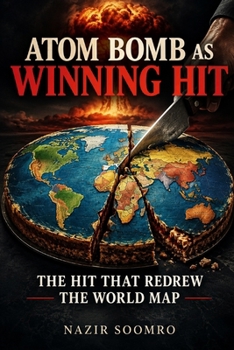
Atom Bomb as Winning Hit: The Hit Redrew the World Map
No Customer Reviews

WHO DREW THE MAP OF THE WORLD?
Look at the map of the world. Do you believe its borders are natural, inevitable, or simply the way things have always been?
Think again.
The world on our cover resembles a cake-cut into pieces, divided, and distributed according to the interests and calculations of those powerful enough to shape its future. Some nations were considered weak, others dangerous. Some were treated as pieces to be claimed, others as powers entitled to decide how the pieces should be divided.
After the First World War, the map was redrawn. After the Second World War, it was redrawn again.
Communities that had lived together for generations found themselves separated by new borders. People who had shared neighbourhoods, markets, festivals and family histories increasingly came to see one another as enemies.
How can a line drawn on a map transform neighbours into enemies?
How did Korea become two states? Why did India and Pakistan emerge from Partition into decades of hostility? How did China's civil war become part of a much larger international struggle over Taiwan? And how did Vietnam's struggle against colonial rule become a major battlefield of the Cold War?
These were not merely changes in geography. They were transformations in political identity, national psychology and international power.
And the consequences did not end when the borders were drawn.
India and Pakistan continued to compete militarily. Korea remained divided. Conflicts, alliances and strategic rivalries persisted. Governments spent enormous sums on defence, while weapons manufacturers supplied an international market shaped by insecurity and fear.
In 2025, global military expenditure reached an estimated $2.887 trillion, according to the Stockholm International Peace Research Institute (SIPRI).
What does this tell us about the world we have created?
Why do nations prepare for the next war even while remembering the suffering caused by the last one? Why do temporary divisions sometimes become permanent? And when a conflict approaches a decisive outcome, what role do negotiations, ceasefires and outside powers play in determining what happens next?
Are these developments simply the consequences of competing national interests? Or do they also reveal patterns in which strategic influence, economic interests and the business of weapons reinforce one another?
This book does not ask readers to accept a ready-made conspiracy theory. It invites them to examine the historical record, question familiar explanations and look more closely at the relationship between borders, power, fear, money and war.
Because the most important question may not be who drew the line.
It may be who benefited from drawing it-and who has paid the price ever since.
The map may look like geography.
But behind its lines lies a history of human decisions, political struggles and consequences that continue to shape our world.
Format:Paperback
Language:English
ISBN:B0HMR3QRCG
ISBN13:9798161834862
Release Date:October 2026
Publisher:Independently Published
Length:302 Pages
Weight:0.89 lbs.
Dimensions:0.6" x 6.0" x 9.0"
Related Subjects
HistoryCustomer Reviews
0 rating
Copyright © 2026 Thriftbooks.com
Terms of Use | Privacy Policy | Do Not Sell/Share My Personal Information | Cookie Notice | Cookie Preferences | Accessibility Statement
ThriftBooks ® and the ThriftBooks ® logo are registered trademarks of Thrift Books Global, LLC
ThriftBooks ® and the ThriftBooks ® logo are registered trademarks of Thrift Books Global, LLC
