


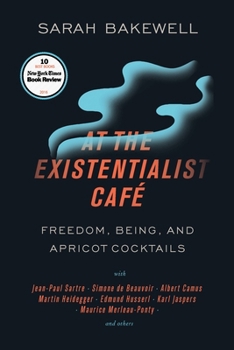
At the Existentialist Café: Freedom, Being, and Apricot Cocktails with Jean-Paul Sartre, Simone de Beauvoir, Albert Camus, Martin Heidegger, Maurice M


Select Format
Select Condition 
Book Overview
Named one of the Ten Best Books of 2016 by the New York Times, a spirited account of a major intellectual movement of the twentieth century and the revolutionary thinkers who came to shape it, by the best-selling author of How to Live and Humanly Possible Sarah Bakewell. Paris, 1933: three contemporaries meet over apricot cocktails at the Bec-de-Gaz bar on the rue Montparnasse. They are the young Jean-Paul Sartre, Simone de Beauvoir, and longtime friend Raymond Aron, a fellow philosopher who raves to them about a new conceptual framework from Berlin called Phenomenology. "You see," he says, "if you are a phenomenologist you can talk about this cocktail and make philosophy out of it "
It was this simple phrase that would ignite a movement, inspiring Sartre to integrate Phenomenology into his own French, humanistic sensibility, thereby creating an entirely new philosophical approach inspired by themes of radical freedom, authentic being, and political activism. This movement would sweep through the jazz clubs and caf s of the Left Bank before making its way across the world as Existentialism.
Featuring not only philosophers, but also playwrights, anthropologists, convicts, and revolutionaries, At the Existentialist Caf follows the existentialists' story, from the first rebellious spark through the Second World War, to its role in postwar liberation movements such as anti-colonialism, feminism, and gay rights. Interweaving biography and philosophy, it is the epic account of passionate encounters--fights, love affairs, mentorships, rebellions, and long partnerships--and a vital investigation into what the existentialists have to offer us today, at a moment when we are once again confronting the major questions of freedom, global responsibility, and human authenticity in a fractious and technology-driven world.
It was this simple phrase that would ignite a movement, inspiring Sartre to integrate Phenomenology into his own French, humanistic sensibility, thereby creating an entirely new philosophical approach inspired by themes of radical freedom, authentic being, and political activism. This movement would sweep through the jazz clubs and caf s of the Left Bank before making its way across the world as Existentialism.
Featuring not only philosophers, but also playwrights, anthropologists, convicts, and revolutionaries, At the Existentialist Caf follows the existentialists' story, from the first rebellious spark through the Second World War, to its role in postwar liberation movements such as anti-colonialism, feminism, and gay rights. Interweaving biography and philosophy, it is the epic account of passionate encounters--fights, love affairs, mentorships, rebellions, and long partnerships--and a vital investigation into what the existentialists have to offer us today, at a moment when we are once again confronting the major questions of freedom, global responsibility, and human authenticity in a fractious and technology-driven world.
Format:Paperback
Language:English
ISBN:1590518896
ISBN13:9781590518892
Release Date:August 2017
Publisher:Other Press (NY)
Length:464 Pages
Weight:1.27 lbs.
Dimensions:1.2" x 5.6" x 8.8"
Customer Reviews
1 rating
Easy to read, enjoyable mix of biography and philosophy
Published by Karen , 10 days ago
I’m about 200 pages into Sarah’s book, and it’s been a real delight—a rare and thoughtful mix of biography and philosophy that brings the early 20th-century thinkers vividly to life. What I appreciate most is how she shows their ideas emerging from lived circumstances rather than floating in abstraction: brilliance and blindness, insight and evasion, unfolding side by side. Her treatment of Heidegger is easily understood and the tension between him and other philosophers during and after the war is masterful! She points out the problems with Sartre and his blind spots as well that Beauvoir addresses. I think each chapter is better than the last and highly recommend. I’ve also gleaned quite a bit of new works to read that she mentions. I almost wish there was a second book here on these topics!
Copyright © 2026 Thriftbooks.com Terms of Use
| Privacy Policy | Do Not
Sell/Share My Personal Information | Cookie Policy | Cookie Preferences | Accessibility Statement
ThriftBooks® and the ThriftBooks® logo are registered trademarks of Thrift Books Global, LLC
ThriftBooks® and the ThriftBooks® logo are registered trademarks of Thrift Books Global, LLC
