


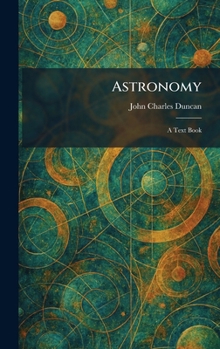
Astronomy: A Text Book

"Astronomy: A Text Book" is a comprehensive and authoritative introduction to the science of the heavens, designed to guide students through the complexities of the universe. Written by John Charles Duncan, this work serves as a foundational resource for understanding the principles of celestial mechanics, the physical nature of the planets, and the vast scale of the cosmos. The text provides a detailed examination of the solar system, including the movements and characteristics of the sun, moon, and planets, while also exploring the broader mysteries of the stars and nebulae.
Duncan's approach balances observational data with mathematical theory, offering clear explanations of the tools and methods used by astronomers to map the night sky. The book addresses the structure of the Milky Way galaxy and the evolution of stellar bodies, reflecting the scientific knowledge and pedagogical standards of the early 20th century. As a significant educational work, "Astronomy: A Text Book" is valued for its clarity and its role in shaping the astronomical literacy of its era. It remains a vital reference for those interested in the history of science and the development of modern astrophysical thought.
This work has been selected by scholars as being culturally important, and is part of the knowledge base of civilization as we know it. This work was reproduced from the original artifact, and remains as true to the original work as possible. Therefore, you may see the original copyright references, library stamps (as most of these works have been housed in our most important libraries around the world), and other notations in the work.
This work is in the public domain in the United States of America, and possibly other nations. Within the United States, you may freely copy and distribute this work, as no entity (individual or corporate) has a copyright on the body of the work.
As a reproduction of a historical artifact, this work may contain missing or blurred pages, poor pictures, errant marks, etc. Scholars believe, and we concur, that this work is important enough to be preserved, reproduced, and made generally available to the public. We appreciate your support of the preservation process, and thank you for being an important part of keeping this knowledge alive and relevant.
Customer Reviews
ThriftBooks ® and the ThriftBooks ® logo are registered trademarks of Thrift Books Global, LLC
