


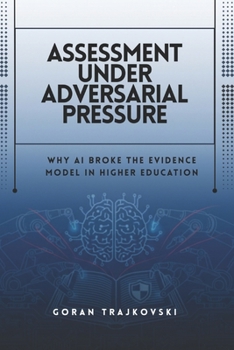
Assessment Under Adversarial Pressure: Why AI Broke the Evidence Model in Higher Education
No Customer Reviews

The detection era is over. The redesign era has begun. Generative AI didn't create a cheating crisis in higher education. It created an evidence crisis. When any student can produce a polished essay, case analysis, or research report in seconds, the artifacts institutions have long treated as proof of learning no longer prove anything at all. The inferential link between what students produce and what students know has been severed. Not by dishonest students, but by a technology that made producing convincing academic work effortless. Most institutions responded the way institutions always respond: they bought tools. AI detection software promised to sort human writing from machine writing and restore the old order. It hasn't worked. Not because the tools aren't clever enough, but because adversarial dynamics guarantee that evasion will always be cheaper, faster, and more accessible than detection. Every improvement in detection triggers a trivial workaround. The arms race is structurally unwinnable, and the institutions investing in it are spending resources and political capital on a strategy that delays the work that actually matters. Meanwhile, the real problem goes unaddressed. Assessment systems across higher education were built for cooperative conditions-environments where producing a convincing academic artifact genuinely required the cognitive work that artifact was supposed to represent. That assumption held for decades. It no longer holds. And no amount of detection, no revised rubric, and no AI-acceptable-use policy will make it hold again. Assessment Under Adversarial Pressure argues that the only durable institutional response is architectural. Not better assignments. Not updated honor codes. Not plagiarism software with a new label. The response is redesigning how evidence of learning is generated, collected, and certified-so that the evidence holds up regardless of what tools students have access to. The book introduces adversarial assessment as a design framework: an approach that treats AI-enabled delegation not as a violation to be policed, but as a permanent condition to be designed around. Drawing on validity theory from educational measurement, adversarial design principles from security engineering, and the most current research available, it provides institutional leaders with a framework for rethinking assessment architecture from the ground up. What this book covers:
- Why detection-based strategies are structurally unwinnable-and why institutions keep pursuing them anyway
- Why the most common assignment redesigns fail under even moderate adversarial pressure
- How adversarial assessment reframes the problem from student behavior to system design
- How to build evidence systems whose trustworthiness comes from conditions, not compliance
- What accreditation bodies are starting to expect-and what their standards still assume
- How to navigate the legal exposure that detection-dependent policies create
- How to sequence institutional change when consensus is slow and the environment moves fast
- Why the real problem was never about AI-it was about evidentiary assumptions that were always fragile Written for: Provosts, deans, assessment directors, accreditation liaisons, institutional effectiveness officers, program directors, faculty senate leaders, department chairs, and graduate students in higher education programs. If your role involves certifying that students have learned what your institution claims they have learned, this book is for you. This is not a teaching guide. It is not a technology review. It is not a defense of AI or an attack on students. It is an argument about institutional architecture-and a practical framework for leaders who cannot afford to wait for the next policy cycle to act.
- Why detection-based strategies are structurally unwinnable-and why institutions keep pursuing them anyway
- Why the most common assignment redesigns fail under even moderate adversarial pressure
- How adversarial assessment reframes the problem from student behavior to system design
- How to build evidence systems whose trustworthiness comes from conditions, not compliance
- What accreditation bodies are starting to expect-and what their standards still assume
- How to navigate the legal exposure that detection-dependent policies create
- How to sequence institutional change when consensus is slow and the environment moves fast
- Why the real problem was never about AI-it was about evidentiary assumptions that were always fragile Written for: Provosts, deans, assessment directors, accreditation liaisons, institutional effectiveness officers, program directors, faculty senate leaders, department chairs, and graduate students in higher education programs. If your role involves certifying that students have learned what your institution claims they have learned, this book is for you. This is not a teaching guide. It is not a technology review. It is not a defense of AI or an attack on students. It is an argument about institutional architecture-and a practical framework for leaders who cannot afford to wait for the next policy cycle to act.
Format:Paperback
Language:English
ISBN:B0GMJ12QBH
ISBN13:9798247536222
Release Date:February 2026
Publisher:Independently Published
Length:102 Pages
Weight:0.32 lbs.
Dimensions:0.2" x 6.0" x 9.0"
Customer Reviews
0 rating
Copyright © 2026 Thriftbooks.com Terms of Use
| Privacy Policy | Do Not
Sell/Share My Personal Information | Cookie Policy | Cookie Preferences | Accessibility Statement
ThriftBooks® and the ThriftBooks® logo are registered trademarks of Thrift Books Global, LLC
ThriftBooks® and the ThriftBooks® logo are registered trademarks of Thrift Books Global, LLC
