


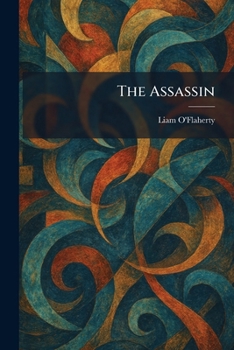
The Assassin

"The Assassin" is a gripping psychological thriller and a seminal work of Irish political fiction by acclaimed author Liam O'Flaherty. Set against the tense, brooding atmosphere of post-Civil War Dublin, the novel delves deep into the fractured mind of Michael McDara, a revolutionary who returns to Ireland with a singular, violent purpose: the assassination of a high-ranking government official. Through a meticulous exploration of McDara's internal struggle, O'Flaherty examines the themes of fanaticism, isolation, and the heavy moral toll of political violence.
Unlike traditional thrillers, "The Assassin" prioritizes the internal landscape of its protagonist, tracing the days of cold deliberation and mounting paranoia leading up to the fateful act. O'Flaherty's stark, naturalistic prose captures the bleakness of an urban landscape scarred by conflict and the spiritual exhaustion of men living on the fringes of society. As a profound study of the revolutionary impulse, the novel remains a powerful testament to the complexities of Irish history and the human psyche. "The Assassin" stands as a landmark achievement in early 20th-century literature, offering a haunting and visceral portrayal of a man driven to the edge by ideology and obsession.
This work has been selected by scholars as being culturally important, and is part of the knowledge base of civilization as we know it. This work was reproduced from the original artifact, and remains as true to the original work as possible. Therefore, you may see the original copyright references, library stamps (as most of these works have been housed in our most important libraries around the world), and other notations in the work.
This work is in the public domain in the United States of America, and possibly other nations. Within the United States, you may freely copy and distribute this work, as no entity (individual or corporate) has a copyright on the body of the work.
As a reproduction of a historical artifact, this work may contain missing or blurred pages, poor pictures, errant marks, etc. Scholars believe, and we concur, that this work is important enough to be preserved, reproduced, and made generally available to the public. We appreciate your support of the preservation process, and thank you for being an important part of keeping this knowledge alive and relevant.
Customer Reviews
great book about moralty
ThriftBooks® and the ThriftBooks® logo are registered trademarks of Thrift Books Global, LLC
