


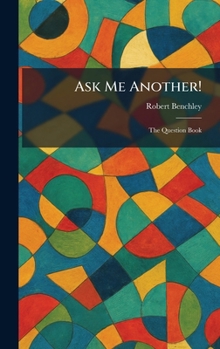
Ask Me Another!: The Question Book

"Ask Me Another The Question Book" captures the spirit of the trivia craze that swept through the 1920s. This engaging collection of general knowledge tests provides a fascinating window into the intellectual and cultural landscape of the early twentieth century. Spanning a diverse array of topics including history, literature, science, and the arts, the book challenges readers with series of questions designed to measure one's information quotient.
Compiled during an era when parlor games and self-improvement were at the height of popularity, this work features contributions and tests from notable figures of the day, including the celebrated humorist Robert Benchley. It serves not only as a nostalgic diversion but also as a rigorous exercise in broad-based learning. Whether used for solo study or as a competitive social activity, "Ask Me Another The Question Book" remains a charming and intellectually stimulating artifact of American social history. It offers readers a unique opportunity to test their wits against the standards of a bygone era while exploring the timeless appeal of the quest for knowledge.
This work has been selected by scholars as being culturally important, and is part of the knowledge base of civilization as we know it. This work was reproduced from the original artifact, and remains as true to the original work as possible. Therefore, you may see the original copyright references, library stamps (as most of these works have been housed in our most important libraries around the world), and other notations in the work.
This work is in the public domain in the United States of America, and possibly other nations. Within the United States, you may freely copy and distribute this work, as no entity (individual or corporate) has a copyright on the body of the work.
As a reproduction of a historical artifact, this work may contain missing or blurred pages, poor pictures, errant marks, etc. Scholars believe, and we concur, that this work is important enough to be preserved, reproduced, and made generally available to the public. We appreciate your support of the preservation process, and thank you for being an important part of keeping this knowledge alive and relevant.
Customer Reviews
ThriftBooks ® and the ThriftBooks ® logo are registered trademarks of Thrift Books Global, LLC
