


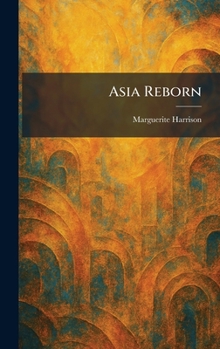
Asia Reborn

"Asia Reborn" is a profound exploration of the seismic political and social shifts that swept across the Asian continent in the wake of the First World War. Written by the intrepid journalist and traveler Marguerite Harrison, this work provides a detailed analysis of the awakening of national consciousness and the gradual erosion of Western imperial dominance. From the modernization of Turkey under Kemal Atat 1/4rk to the revolutionary movements in China and the rising ambitions of Japan, Harrison offers a comprehensive overview of a continent in the throes of radical transformation.
The book delves into the complex interplay of cultural traditions and modern political ideologies, examining how various nations sought to redefine their identities and secure their independence. Harrison's firsthand observations and sharp journalistic insight make "Asia Reborn" an invaluable historical document for understanding the roots of modern Asian geopolitics. It captures a pivotal moment in global history when the traditional balance of power was shifting, setting the stage for the conflicts and triumphs of the twentieth century. This narrative is essential for readers interested in international relations, the history of decolonization, and the enduring legacy of the Great War on the East.
This work has been selected by scholars as being culturally important, and is part of the knowledge base of civilization as we know it. This work was reproduced from the original artifact, and remains as true to the original work as possible. Therefore, you may see the original copyright references, library stamps (as most of these works have been housed in our most important libraries around the world), and other notations in the work.
This work is in the public domain in the United States of America, and possibly other nations. Within the United States, you may freely copy and distribute this work, as no entity (individual or corporate) has a copyright on the body of the work.
As a reproduction of a historical artifact, this work may contain missing or blurred pages, poor pictures, errant marks, etc. Scholars believe, and we concur, that this work is important enough to be preserved, reproduced, and made generally available to the public. We appreciate your support of the preservation process, and thank you for being an important part of keeping this knowledge alive and relevant.
Customer Reviews
ThriftBooks ® and the ThriftBooks ® logo are registered trademarks of Thrift Books Global, LLC
