


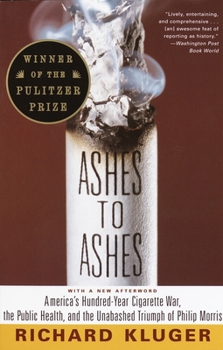
Ashes to Ashes: America's Hundred-Year Cigarette War, the Public Health, and the Unabashed Triumph of Philip Morris

Select Format
Select Condition 
Book Overview
PULITZER PRIZE WINNER - No book before this one has rendered the story of cigarettes--mankind's most common self-destructive instrument and its most profitable consumer product--with such sweep and enlivening detail. "A great battleship of a book--formidable, majestic."--The New York Times Book Review
Here for the first time, in a story full of the complexities and contradictions of human nature, all the strands of the historical process--financial, social, psychological, medical, political, and legal--are woven together in a riveting narrative. The key characters are the top corporate executives, public health investigators, and antismoking activists who have clashed ever more stridently as Americans debate whether smoking should be closely regulated as a major health menace. We see tobacco spread rapidly from its aboriginal sources in the New World 500 years ago, as it becomes increasingly viewed by some as sinful and some as alluring, and by government as a windfall source of tax revenue. With the arrival of the cigarette in the late-nineteenth century, smoking changes from a luxury and occasional pastime to an everyday--to some, indispensable--habit, aided markedly by the exuberance of the tobacco huskers. This free-enterprise success saga grows shadowed, from the middle of this century, as science begins to understand the cigarette's toxicity. Ironically the more detailed and persuasive the findings by medical investigators, the more cigarette makers prosper by seeming to modify their product with filters and reduced dosages of tar and nicotine. We see the tobacco manufacturers come under intensifying assault as a rogue industry for knowingly and callously plying their hazardous wares while insisting that the health charges against them (a) remain unproven, and (b) are universally understood, so smokers indulge at their own risk. Among the eye-opening disclosures here: outrageous pseudo-scientific claims made for cigarettes throughout the '30s and '40s, and the story of how the tobacco industry and the National Cancer Institute spent millions to develop a "safer" cigarette that was never brought to market. Dealing with an emotional subject that has generated more heat than light, this book is a dispassionate tour de force that examines the nature of the companies' culpability, the complicity of society as a whole, and the shaky moral ground claimed by smokers who are now demanding recompense.
Here for the first time, in a story full of the complexities and contradictions of human nature, all the strands of the historical process--financial, social, psychological, medical, political, and legal--are woven together in a riveting narrative. The key characters are the top corporate executives, public health investigators, and antismoking activists who have clashed ever more stridently as Americans debate whether smoking should be closely regulated as a major health menace. We see tobacco spread rapidly from its aboriginal sources in the New World 500 years ago, as it becomes increasingly viewed by some as sinful and some as alluring, and by government as a windfall source of tax revenue. With the arrival of the cigarette in the late-nineteenth century, smoking changes from a luxury and occasional pastime to an everyday--to some, indispensable--habit, aided markedly by the exuberance of the tobacco huskers. This free-enterprise success saga grows shadowed, from the middle of this century, as science begins to understand the cigarette's toxicity. Ironically the more detailed and persuasive the findings by medical investigators, the more cigarette makers prosper by seeming to modify their product with filters and reduced dosages of tar and nicotine. We see the tobacco manufacturers come under intensifying assault as a rogue industry for knowingly and callously plying their hazardous wares while insisting that the health charges against them (a) remain unproven, and (b) are universally understood, so smokers indulge at their own risk. Among the eye-opening disclosures here: outrageous pseudo-scientific claims made for cigarettes throughout the '30s and '40s, and the story of how the tobacco industry and the National Cancer Institute spent millions to develop a "safer" cigarette that was never brought to market. Dealing with an emotional subject that has generated more heat than light, this book is a dispassionate tour de force that examines the nature of the companies' culpability, the complicity of society as a whole, and the shaky moral ground claimed by smokers who are now demanding recompense.
Format:Paperback
Language:English
ISBN:0375700366
ISBN13:9780375700361
Release Date:July 1997
Publisher:Vintage
Length:832 Pages
Weight:1.49 lbs.
Dimensions:1.9" x 5.2" x 7.9"
Customer Reviews
4 ratings
Great history book
Published by Thriftbooks.com User , 20 years ago
Just about every great society has one crop whose presence is intertwined throughout its history, effecting the history, culture, and economics of the nation. For China it would be rice, potatoes for Ireland, coca for Columbia, and most likely tobacco for America. This Pulitzer-Prize winning book shows how and why tobacco is so important to America's history. Specifically, the book traces and examines the economic role of tobacco and the economic policies of the tobacco companies (growers, traders, sellers, etc...) from the 1800s on through the 1990s. Subjects that are covered in this tome include tobacco farming, the making of cigarettes, advertising in papers, radio, TV and billboards, lobbying of govt officials to reduce regulation, PR wars with health advocates, promotion of overseas sales, and of course, the court cases fought between Big Tobacco (RJR,Philip Morris, Brown & Williamson, etc...) and various consumers, consumer groups, government agencies, and governments. The book puts all of this together in a chronological history of tobacco with an emphasis on the role of big corporations like Philip Morris. The author has put this book together using a wide variety of sources both primary and secondary, including a lot of interviews with former and current employees at tobacco companies. By reading this book, one learns a lot about various aspects of American law, culture, economics, and history. These include consumer relations, agro-business, medical research, lobbying, and advertising. OVerall, this is a great book, and I highly recommend it for anyone to read.
Oddly gripping...
Published by Thriftbooks.com User , 25 years ago
I purchased this book to do some research for a project I was working on. It was my intention to skim through the first three-quarters and then to pull what I needed from the last quarter. I ended up reading every word. You would think that a book this large (it's even larger than you think-the print and margins are really small) wouldn't be able to hold your interest, but the author does a wonderful job of relating people and events, while keeping the narrative moving ever forward. The reader comes away with the thought that the history of tobacco is so intertwined with the history of America that it is often difficult to tell them apart. From Jamestown, to the world wars, to the recent lawsuits that have plagued the industry, we see the triumphs and failures of capitalism and freedom, and begin to understand how they can be so wonderful and dangerous at the same time.
Exhaustive and thorough history
Published by Thriftbooks.com User , 26 years ago
This is not a book for a quick casual read. Kluger offers a comprehensive, thoroughly researched, and exhaustive history of the cigarette industry in this country. I was fascinated to learn of the backgrounds of the major players, and the data leaves no question that they deliberately set out to addict customers with full knowledge of the consequences. You'll never look at a cigarette ad or display the same way again.
One of the most thorough and best books on the tobacco ind.
Published by Thriftbooks.com User , 28 years ago
This book is a masterpiece by Dick Kluger. It covers every aspect of the tobacco industry. FromNewport to the Native-Americans. It was enjoyable, well written, informative and objective. Despite the current climate of anti-smoking, Kluger takes a neutral; he wasn't a shill for Philip Morris and he wasn't a shill form Willaim Novilli and the rest of the anti-tobacco crazys. After you read this book, you will know everything that there is to know about tobacco and cigarettes. He fulfils everything that was promised in the sub-title: Americas hundred year cigarette war - check. The Public Health- check. The unabashed trimph of Philip Morris double-check. I couldn't put this book down. You think that this book is only a few pages- despite it's 800 pages. It is fast reading. And it will be one of the best books you'll ever read!
Copyright © 2025 Thriftbooks.com
Terms of Use | Privacy Policy | Do Not Sell/Share My Personal Information | Cookie Policy | Cookie Preferences | Accessibility Statement
ThriftBooks ® and the ThriftBooks ® logo are registered trademarks of Thrift Books Global, LLC
ThriftBooks ® and the ThriftBooks ® logo are registered trademarks of Thrift Books Global, LLC
