


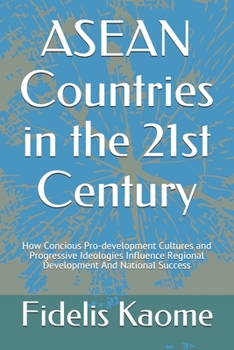
ASEAN Countries in the 21st Century: How Concious Pro-development Cultures and Progressive Ideologies Influence Regional Development And National Succ
No Customer Reviews

This research focuses on the relationship between ideological views and regional integration within the Association of South-East Asian Nations and its member states. The ASEAN bloc is of particular interest largely because it has become a force to recognise after the European Union as one of the powerful and effective regional institutions in the 21st century. This research utilised a mixed-method research methodology approach. It has been discussed in this research that ASEAN has been successful on the economic pillar compared to the political and social structures. Although colonialism and imperialism had devastating effects on ASEAN like in any other formerly colonised regions it has been identified that it is modern ASEAN's drive and adaptability that has inspired the top six performing states in ASEAN to be forces to recognise as well. The top-performing economies include Indonesia, Thailand, Malaysia, the Philippines, Singapore and Vietnam whose economic miracle and progressive drive has shocked the world just like the German and Japanese economic miracles during the 20th century after the Second World War. It is also important to take note that belonging to a highly successful regional organisation does not mean economic development for a member state unless effective steps to eliminate corruption and promote transparency have been put in place side by side with a progressive and effective economic development master plan. Effective legal, political, social and economic institutions at national and local levels among a bloc's party states result in a spillover effect that positively affects regional development and integration as well. Based on the statistics up until 2020 the South East Asian states of Brunei, Cambodia, Laos PDR and Myanmar need to come up with more pragmatic policies so that they too experience the Midas Touch their fellow Asians have experienced. Whilst natural resources are important for a state they must not be the primary foundation that determines a state's success but instead progressive and effective institutional frameworks. It is therefore the main argument of this research that culture influences development to a great extent. The research uses the Liberalism theory as far as institutionalism is concerned. Indeed the Pygmalion effect is a reality as can be seen in the continuous rise of the top six performing nations who have brought their ideals in running the ASEAN bloc to be a top contender ranked in the top ten (10) trillion economies in the same ranks of China, Japan, France, Germany and USA. In this research, it is largely recommended that ASEAN unite in dealing with the great powers and that effective action be taken for party states to have common values and ideals.Overview1 - The Origins and History of the Association of South-East Asian Nations (20th and 21st Century)2 - Functions, Duties and the Effectiveness of the Association of Southeast Asian Nations Bloc3 - The Colonial Legacy, Globalisation and Liberalism on the Association of Southeast Asian Nations's Development4 - The Association of Southeast Asian Nations's International Relations 5 - Regional Ideologies Promoting Development: The Concepts of ASEAN Identity and the ASEAN Way6 - Challenges and Threats faced in ASEAN's Quest for Development and Advancement in International Affairs
Format:Paperback
Language:English
ISBN:B08NRWD8RP
ISBN13:9798566349374
Release Date:November 2020
Publisher:Independently Published
Length:88 Pages
Weight:0.28 lbs.
Dimensions:0.2" x 6.0" x 9.0"
Customer Reviews
0 rating
Copyright © 2026 Thriftbooks.com Terms of Use
| Privacy Policy | Do Not
Sell/Share My Personal Information | Cookie Policy | Cookie Preferences | Accessibility Statement
ThriftBooks® and the ThriftBooks® logo are registered trademarks of Thrift Books Global, LLC
ThriftBooks® and the ThriftBooks® logo are registered trademarks of Thrift Books Global, LLC
