


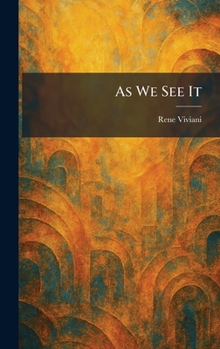
As We See It

"As We See It" provides an essential firsthand perspective on the political and diplomatic landscape of early 20th-century Europe. Written by Rene Viviani, who served as the Prime Minister of France during the outbreak of the Great War, this work serves as a powerful defense of French policy and a detailed examination of the events leading to the global conflict. Viviani meticulously addresses the complex web of alliances, the mobilization of armies, and the intense diplomatic negotiations that defined the summer of 1914.
Through this account, readers gain unique insight into the French government's internal deliberations and its official stance regarding international tensions. The book acts as a primary source rebuttal to post-war narratives that sought to redistribute the burden of responsibility for the war, offering a narrative rooted deeply in the French experience. It explores themes of national security, international law, and the fragile pursuit of peace in a period of unprecedented global upheaval.
As a significant historical document, "As We See It" is indispensable for students of World War I, European history, and international relations. It captures the spirit of a nation under pressure and the intellectual rigor of a statesman seeking to justify his country's actions. Viviani's prose reflects the gravity of the era, making it a compelling read for anyone seeking to understand the origins of modern warfare.
This work has been selected by scholars as being culturally important, and is part of the knowledge base of civilization as we know it. This work was reproduced from the original artifact, and remains as true to the original work as possible. Therefore, you may see the original copyright references, library stamps (as most of these works have been housed in our most important libraries around the world), and other notations in the work.
This work is in the public domain in the United States of America, and possibly other nations. Within the United States, you may freely copy and distribute this work, as no entity (individual or corporate) has a copyright on the body of the work.
As a reproduction of a historical artifact, this work may contain missing or blurred pages, poor pictures, errant marks, etc. Scholars believe, and we concur, that this work is important enough to be preserved, reproduced, and made generally available to the public. We appreciate your support of the preservation process, and thank you for being an important part of keeping this knowledge alive and relevant.
Customer Reviews
ThriftBooks® and the ThriftBooks® logo are registered trademarks of Thrift Books Global, LLC
