





Book Overview
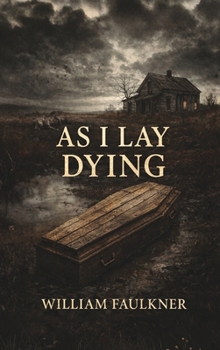
A haunting portrait of family, loss, and human resilience. In As I Lay Dying, William Faulkner tells the powerful story of the Bundren family as they journey across rural Mississippi to fulfill their mother's final wish-to be buried in her hometown. Told through multiple perspectives, each voice reveals raw emotions, hidden tensions, and deeply personal struggles. Faulkner's groundbreaking narrative style captures the complexity of human thought, offering an intimate glimpse into grief, duty, and the bonds that both unite and divide us. As the journey unfolds, what begins as a simple promise transforms into a profound exploration of love, sacrifice, and survival. Dark, moving, and deeply human, As I Lay Dying is a modern classic that continues to resonate with readers who appreciate layered storytelling and emotional depth.
Format:Hardcover
Language:English
ISBN:9378643868
ISBN13:9789378643866
Release Date:April 2026
Publisher:Kalamos Literary Services Llp
Length:168 Pages
Weight:0.87 lbs.
Dimensions:0.5" x 6.0" x 9.0"
Customer Reviews
5 ratings
As I Lay Dying
Published by EmStockard , 3 years ago
As a Northerner, it was very difficult to understand the Southern talk.
Incredible Ending
Published by Mathew , 5 years ago
I'm not sure any ending to a story touched me as much as this one. A real shock. And sadly a believable one.
I'm interested in reading the uncorrected text instead of this corrected text copy that I see everywhere. The uncorrected text sounds so much more interesting but I can't find it anywhere.
If anyone knows where to find it please let me know.
Rubbernecking on the Literary Highway
Published by Thriftbooks.com User , 19 years ago
I was re-reading this book last week, pen and highlighter in hand, when my husband walked into the living room and said, "What are you reading?" I lifted the cover. "Is it any good?" To which I replied, "No," and he responded, "Why are you reading it?" And, slightly irritated, I said, "For the same reason you are watching the American Idol Audition show. It's DEFINITELY not good, but you can't look away." And so it is with most of Faulkner's work. As a reader, you should not go into his work expecting anything "good." You won't find an easy or clear plotline, clear language, or (and this is USUALLY a major gripe of mine) likeable characters. But even though you don't really like what you are reading, you just have to know how it ends. You have to know what makes these reprehensible people tick. And, surprisingly enough, you are usually unsatisfied in the end, but not so much that you don't want to double back and have one more look at the car-wreck that is the work of Faulkner. And so it is with *As I Lay Dying*. It's a fascinating piece of work, masterfully crafted, ultimately depressing, and darkly funny all at once. Having been to Rowan Oak a few times, I can see Faulkner sitting in his front garden chuckling over the idea of Vardaman's infamous "My Mother is a fish," chapter and how it captivated the world with it's "brilliance." I also have no doubt, having grown up in Mississippi, that he was writing about real people, warts and all. I'm probably related to some of them. Maybe for that reason, Faulkner reads a little differently to locals. While I certainly appreciate his literary genius, the truth and realism of what he wrote also shines through. Reading Faulkner is a little like attending a funeral in Mississippi, something that closely resembles a family reunion set anywhere else - everybody's talking at once (in the most genteel manner, except for that blacksheep son - we all know he's not his Daddy's child, bless his heart - who keeps using bad language) about stuff that would absolutely curl the toenails of anyone is polite "society." The stream-of-consciousness style reminds me very much of what I picked up on as a child overhearing these conversations in the viewing room of the funeral parlor. So . . . read with an open mind. And if the humor throws you at first, find a copy of the short story of *A Rose for Emily*. It will help you to better understand what Faulkner considered funny. Though off on other literary journeys, I'm sure that eventually my morbid curiousity will draw me back to this trainwreck again before too long . . . just can't stop looking . . .
Pilgrim's Progress to the Promised Land
Published by Thriftbooks.com User , 26 years ago
Faulkner's great accomplishment in this novel is to use the most modern fiction techniques to create a timeless allegory that we would probably not accept in a different style. His other great achievement is to leave so much space in the story for us to participate in adding meaning. You have to pay attention to even notice what is going on, and then you can provide a variety of interpretations. This novel will never be the same for any two readers. It is a stunning accomplishment, as a result.The story begins as Addie Bundren lays dying, fanned by her daughter, while her son makes her coffin. With her husband and five children, we make her acquaintance by learning about their actions and characters. Only once does she have a role as a narrator, and then, quite late in the story. Her husband, Anse, has promised her that he will bury her with her family. Because of tremendous rains, the river has risen, knocking out bridges and making passage difficult. Despite this, the family perserveres in taking her unembalmed body to the intended burial site. Along the way, there are many mishaps and the family is burdened in many ways by keeping this promise. As the burial comes closer, new elements of the story are exposed and develop that totally recast what you have thought was going on. On the very last page (don't read it first!) is such a plot reversal as only a short story writer would normally have dared. The story is a difficult one to read. So read this book when you have time to pay close attention and study the text word by word. Let me explain the difficulties you will encounter. First, the voices in the book use a Southern patois that will be unfamiliar to most. This is the language of the rural poor in the 1930s, which few have heard. Second, the exposition is mostly through thoughts, often expressed in fragmentary form, rather than through action and a smooth narrative. Third, the narration is a partial mosaic of impressions of the characters, jumping back and forth in 2-4 page segments. Their perceptions are partial, and even more partially expressed. Objectivity is shunned by Faulkner. Fourth, Faulkner wants you to fill in the gaps, and the best way to do that is to expose the gaps slowly. Only after 3 or 4 narrations by characters will the gaps begin to emerge in a way you can grasp them. Then, you still have to interpret them.Few readers will miss the references to Moses and his search for the promised land, and the Christian parable of the Pilgrim's Progress. What is unstated is the connection to reading. Many poor Southern people of that time were taught to read with The Pilgrim's Progress as a primer. That experience helped to shape a perception and a sensibility that would influence their actions, and thus, this tale. That connection creates a wonderful series of circles here that build on one another. At bottom though, it is clear from this book that there are secret
The book which 'Last Orders' copies from
Published by Thriftbooks.com User , 29 years ago
Graham Swift's Booker prize winning novel is an unashamedly disguised version of Faulkner's brilliant novel. It has some of his finest passages in it including the famous one-line chapter of mothers being a fish
As I Lay Dying Mentions in Our Blog

The Beauty of Exploring Poetry
Published by William Shelton • April 27, 2023
As a reader, and an avid one at that, I struggle to apply the same level of zeal to poetry as I have my more preferred topics, such as historic fiction, or biography. Yet every April, when the lilac bushes in my lawn are thronged with flowers, I find myself quoting, "When lilacs last in the dooryard bloomed…"
Copyright © 2026 Thriftbooks.com
Terms of Use | Privacy Policy | Do Not Sell/Share My Personal Information | Cookie Policy | Cookie Preferences | Accessibility Statement
ThriftBooks ® and the ThriftBooks ® logo are registered trademarks of Thrift Books Global, LLC
ThriftBooks ® and the ThriftBooks ® logo are registered trademarks of Thrift Books Global, LLC
