


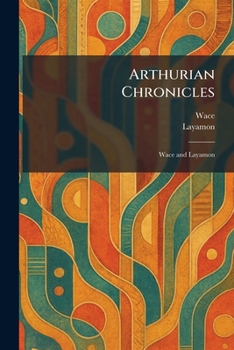
Arthurian Chronicles: Wace and Layamon

"Arthurian Chronicles: Wace and Layamon" brings together two foundational texts that shaped the legendary history of Britain and the enduring mythos of King Arthur. This collection includes the work of Wace, a 12th-century Norman poet whose "Roman de Brut" first introduced the iconic Round Table to the Arthurian tradition, and Layamon, whose early 13th-century Middle English poem "Brut" represents the first major treatment of Arthur in the English language.
These chronicles serve as a vital link between historical record and poetic invention, detailing the rise of the British kingdom and the heroic exploits of its most famous monarch. Wace's contribution reflects the courtly elegance of the Anglo-Norman period, while Layamon's vigorous verse infuses the narrative with an epic, Old English sensibility. Together, they provide a comprehensive look at the evolution of the Arthurian cycle, from the king's miraculous birth and the gathering of his knights to the tragic end of his reign. For scholars of medieval literature and fans of Arthurian lore, these works remain indispensable primary sources that capture the transition from oral tradition to written masterpiece.
This work has been selected by scholars as being culturally important, and is part of the knowledge base of civilization as we know it. This work was reproduced from the original artifact, and remains as true to the original work as possible. Therefore, you may see the original copyright references, library stamps (as most of these works have been housed in our most important libraries around the world), and other notations in the work.
This work is in the public domain in the United States of America, and possibly other nations. Within the United States, you may freely copy and distribute this work, as no entity (individual or corporate) has a copyright on the body of the work.
As a reproduction of a historical artifact, this work may contain missing or blurred pages, poor pictures, errant marks, etc. Scholars believe, and we concur, that this work is important enough to be preserved, reproduced, and made generally available to the public. We appreciate your support of the preservation process, and thank you for being an important part of keeping this knowledge alive and relevant.
Customer Reviews
ThriftBooks ® and the ThriftBooks ® logo are registered trademarks of Thrift Books Global, LLC
