


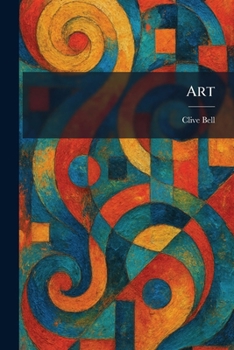
Art

"Art" by Clive Bell is a foundational text in the history of modern art theory and aesthetic philosophy. In this influential work, Bell introduces and champions the concept of significant form, a principle that redefined the way critics and the public evaluate visual expression. Bell argues that the true value of a work of art does not reside in its representational accuracy or its ability to tell a story, but rather in its capacity to provoke a specific aesthetic emotion through the harmonious arrangement of lines, colors, and shapes.
As a prominent member of the Bloomsbury Group, Bell provides a spirited defense of modernism and post-impressionism, challenging the academic traditions of the Victorian era. The book explores the "aesthetic hypothesis," the connection between art and human experience, and the historical progression of artistic movements. By focusing on the essential qualities that make an object a work of art, Bell offers a provocative and enduring framework for understanding beauty and creativity.
Written with clarity and intellectual rigor, "Art" remains an essential volume for art historians, philosophers, and anyone interested in the fundamental principles that govern the world of visual arts. It continues to serve as a vital manifesto for the appreciation of form and the intrinsic power of artistic creation.
This work has been selected by scholars as being culturally important, and is part of the knowledge base of civilization as we know it. This work was reproduced from the original artifact, and remains as true to the original work as possible. Therefore, you may see the original copyright references, library stamps (as most of these works have been housed in our most important libraries around the world), and other notations in the work.
This work is in the public domain in the United States of America, and possibly other nations. Within the United States, you may freely copy and distribute this work, as no entity (individual or corporate) has a copyright on the body of the work.
As a reproduction of a historical artifact, this work may contain missing or blurred pages, poor pictures, errant marks, etc. Scholars believe, and we concur, that this work is important enough to be preserved, reproduced, and made generally available to the public. We appreciate your support of the preservation process, and thank you for being an important part of keeping this knowledge alive and relevant.
Customer Reviews
ThriftBooks ® and the ThriftBooks ® logo are registered trademarks of Thrift Books Global, LLC
