


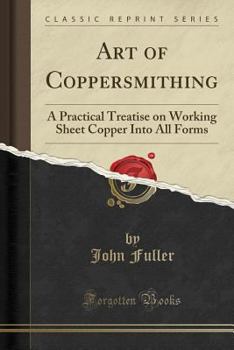
Art of Coppersmithing: A Practical Treatise on Working Sheet Copper Into All Forms (Classic Reprint)


Select Format
Select Condition 
Book Overview
Excerpt from Art of Coppersmithing: A Practical Treatise on Working Sheet Copper Into All Forms And while the aspirations of my youth died away amid the busy' turmoil of mechanical life, and smoldered for years (with an occasional burst of warmth), the thoughts were still cherished, and I began without any preparation, save my memory, to give the helpless boys of the trade reliable instruction in things they should know in starting out to acquire the Art of Coppersmithing. I did my best to tell from my own experience, in the most lucid manner, that which is being called for in everyday life, in three separate branches of the copper trade, sup posing with each lesson there was a good boy at my side. I am pleased with the result of my first effort, which was in a measure impromptu. It will not, however, make Coppersmiths of any one without effort and application, but I trust it will be a help to all who have need of assist ance, and be an incentive to boys to exercise whatever talents they may possess for their own benefit and that of others less fortunate. Before closing my few introductory remarks I desire to tender thanks to the metal worker for the opportunity afforded me for the consummation of my work. About the Publisher Forgotten Books publishes hundreds of thousands of rare and classic books. Find more at www.forgottenbooks.com This book is a reproduction of an important historical work. Forgotten Books uses state-of-the-art technology to digitally reconstruct the work, preserving the original format whilst repairing imperfections present in the aged copy. In rare cases, an imperfection in the original, such as a blemish or missing page, may be replicated in our edition. We do, however, repair the vast majority of imperfections successfully; any imperfections that remain are intentionally left to preserve the state of such historical works.
Format:Paperback
Language:English
ISBN:1332000185
ISBN13:9781332000180
Release Date:August 2018
Publisher:Forgotten Books
Length:354 Pages
Weight:1.04 lbs.
Dimensions:0.7" x 6.0" x 9.0"
Customer Reviews
5 ratings
Great read for the metal enthusiast.
Published by Thriftbooks.com User , 16 years ago
I bought this book because I have been wanting to work with sheet copper. This book seems to focus on practical uses of copper. Creating and repairing pots, pans, teakettles, ect... This book is not only a lesson on how to work copper but it also emphasizes the role of the apprentice or 'boy' as it is mentioned in the book. I find it important to see that one should not expect to jump right into smithing copper. The 'boys' of that time had to pay their dues and rise up through the ranks in order to gain the trust of the teacher. I did find it difficult to find some of the illustrations. Perhaps when this book was revised they removed some of the drawings. This book is the real deal. I would recommend this book to anyone who is interested in the art and history of metalwork.
Not a DIY guide
Published by Thriftbooks.com User , 17 years ago
This is a fascinating insight into the climate in which coppersmiths worked in the 19th Century, and the techniques they used. It is of limited utility in the 21st Century for somebody wanting tips on repairing domestic copperware. As collectors of old kitchenware, we have found the book useful in helping to assess the age and quality of pieces we come across by better understanding makers' techniques. In short, a fascinating addition to the bookshelf, but not a DIY guide.
Art of Coppersmithing
Published by Thriftbooks.com User , 19 years ago
a very informative treatise on an "Old World" art that few know how to do in todays industrialized and technological society. Remarkable, Very easy to read and follow. Will become your reference when need arises!
No other book even comes close in this topic.
Published by Thriftbooks.com User , 22 years ago
This book shows how to make every kind of pot, pan, still, kettle, teakettle or brewry gadget that you would want to make out of copper. Big and small. Household and industrial. Although, dealing exclusively with copper, most of the techniques shown can be applied to other common sheet metals. This book doesn't deal with raising from the whole, as in silversmithing, but with piecing something together, and using dovetail joints along with soldering to make a whole. Lots of woodcut illustrations and concise text. There is some obscure and obsolete terminology; such as 'spelter'. Do you know what that is? Spinning, dies, power presses and such are not delt with in this book. Neither are the common sheet metal gadgets and tools, such as slip rolls, brakes, shears, roll crimps, and such. Hand hammering, stakes, charcoal firepots; that is what you will find in here. This is like blacksmithing for copper. If you are interested in working with copper sheet, or brass,I have not seen another book out there as good as this one. Especially if you want to make utilitarian objects. The book is packed with information. If you are interested in artistic copper forming you will still find the basic techniques in here as to how to work the copper. But there isn't much in the way of artistic design, like how to make a copper rooster weather vane.
Deserves much consideration
Published by Thriftbooks.com User , 22 years ago
This book I believe deserves much praise. The Astragal Press have here reprinted a book written in 1893 which highlights skills that in my part of the world have essentially disappeared. With the technological progress that has sweep across the western world since this book was written you would I suspect have to travel to India, Iran or maybe Eygpt to see this sort of hand skill in use today.In the authors day copper was the metal of choice for making the Glue Pots and Tea kettles, the Stock Pots, Frying Pans, Tallow Coppers and Brewing Coppers to name just a small aray of items listed in this book. Today the vast bulk of these would be manufactured from either Stainless Steel or may Aluminium. So the author desribes with words and some outstanding drawings how these items could have been constructed during this period. Pattern Development of some of the items is also covered. The universal subjects of Soldering and Brazing do get good coverage as does the subject of Tinning a copper to be used for cooking purposes. He has included formula for working out some of the blanks required to start from and some good descriptions of the hand tools and stakes etc. to form the work with and on.A previous reviewer has said that this book is mainly a historical text and of little practical worth today. This is valid only up to a point. It is my belief that this book does have a practical worth and anyone who is looking at this book will be looking precisely for what this book delivers on. That is that this book is about crafting and the art of working metal. The skill to plastically deform a metal to a desired shape is very well covered here and I think that there is a movement, even if a small one, to relearn some of the skills lost in the last few decades with the march of technology. I work in a sheetmetal fabrication shop and no one has these skills anymore and some will say "so what!". But when a job comes in with compounding curved surfaces it is to books from this generation that we must return.The book itself has been well manufactured though I would have perferred a hard cover. Both the Table of Contents and the Index are clear and concise. I therefore give this book 5 stars and believe that if you want to do some serious metal working in your job or at home as a hobby then this book will serve you very well.
Copyright © 2026 Thriftbooks.com
Terms of Use | Privacy Policy | Do Not Sell/Share My Personal Information | Cookie Notice | Cookie Preferences | Accessibility Statement
ThriftBooks ® and the ThriftBooks ® logo are registered trademarks of Thrift Books Global, LLC
ThriftBooks ® and the ThriftBooks ® logo are registered trademarks of Thrift Books Global, LLC
