


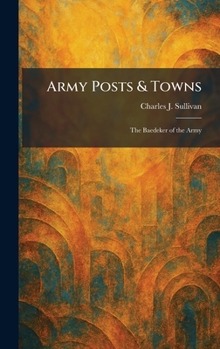
Army Posts & Towns: The Baedeker of the Army

"Army Posts & Towns the Baedeker of the Army" is a comprehensive reference guide designed to serve as an essential companion for military personnel and their families during the interwar period. This detailed volume functions as a practical directory, providing an exhaustive look at United States Army posts and the surrounding towns as they existed in the mid-1920s.
Modeled after the famous Baedeker travel series, the work offers vital information on local geography, transportation, housing, and social amenities available at each station. By cataloging the infrastructure and community life of the American military, Charles J. Sullivan provides a thorough overview of the domestic and overseas installations that defined the service experience of the era. It details the logistical realities of military life, from the proximity of post offices to the availability of local entertainment and schools.
Today, "Army Posts & Towns the Baedeker of the Army" stands as a significant historical document. It offers researchers and military enthusiasts a precise snapshot of the U.S. Army's footprint during a time of institutional change. From the logistical details of post life to the descriptions of neighboring civilian communities, this work captures the unique cultural and physical landscape of the 1920s military world.
This work has been selected by scholars as being culturally important, and is part of the knowledge base of civilization as we know it. This work was reproduced from the original artifact, and remains as true to the original work as possible. Therefore, you may see the original copyright references, library stamps (as most of these works have been housed in our most important libraries around the world), and other notations in the work.
This work is in the public domain in the United States of America, and possibly other nations. Within the United States, you may freely copy and distribute this work, as no entity (individual or corporate) has a copyright on the body of the work.
As a reproduction of a historical artifact, this work may contain missing or blurred pages, poor pictures, errant marks, etc. Scholars believe, and we concur, that this work is important enough to be preserved, reproduced, and made generally available to the public. We appreciate your support of the preservation process, and thank you for being an important part of keeping this knowledge alive and relevant.
Customer Reviews
ThriftBooks ® and the ThriftBooks ® logo are registered trademarks of Thrift Books Global, LLC
