


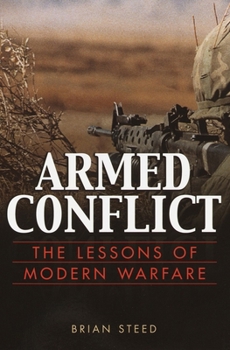
Armed Conflict: The Lessons of Modern Warfare


Select Format
Select Condition 
Book Overview
What challenges will America face in armed conflicts of the future and how will we prepare for them? National security depends upon the ability of the military to "predict" the future nature of war. Despite the difficulty in making such predictions, one must remember: nation states and other countries will continue to use armed conflict as a means to further their aims, and these aims will, at times, run contrary to American interests. As a result, the United States will continue to be confronted with armed conflict in the days and years ahead. A military theorist and experienced armor officer, Brian Steed provides insights into the future of armed conflict by focusing on what has occurred in the past-not because the past repeats itself, but because it reveals timeless principles of warfare. Five battles, one each in Korea, Vietnam, the Falklands, the Persian Gulf, and Somalia are analyzed historically, geographically, and strategically. Steed's analysis of these engagements clearly demonstrates that the key to victory on the battlefields of the future is the small unit. In refreshing layman's prose, the author focuses on why the events occurred as they did, and explores the significance of each battle in terms of its political and military ramifications. He concludes with lessons learned that will greatly benefit future American ground combat commanders. Armed Conflict informs the reader about the historical trends of combat operations and the realities of war-today and into the future. It will also serve to guide a new generation of military and civilian leaders as they prepare to face the inevitable conflicts in the new century.
Format:Paperback
Language:English
ISBN:0891418032
ISBN13:9780891418030
Release Date:January 2003
Publisher:Presidio Press
Length:304 Pages
Weight:0.80 lbs.
Dimensions:0.8" x 6.1" x 8.0"
Customer Reviews
2 ratings
Important to all. A must read for military professionals.
Published by Thriftbooks.com User , 23 years ago
Post Gulf War military theorists, politicians, and the professional military struggle to define the character of warfare in the 21st Century. As a nation, we attempt to understand lessons learned and the implications of military operations in the Balkans and Afghanistan; this extends to the current potential of conflict in Southwest and Southeast Asia. In his book, Armed Conflict: The Lessons of Modern War, Brian Steed seeks to define the challenges that America will face in future armed conflicts and how the United States armed forces might prepare for them.The public and defense industry remain enamored with and focused on the technological advantage that the United States holds over those countries, rogue states and organizations that might threaten our national security and interests in the future. Recent books and articles on this subject do little to analyze other variables that influence the success and failures of recent military operations. Steed posits that technology alone is not and should not be the centerpiece of our militaries' transformation. In fact, Steed sees what may be an over reliance on technology in preparing for future conflicts as our nations Achilles Heel.With great clarity, Steed lays the foundation for his thesis in introductory chapters by identifying the global variables that have and will continue to influence future conflicts. In following chapters, he conducts five battle analyses spanning almost fifty years of military conflict to highlight what he sees as the more important characteristics that facilitate success in military operations - against a variety of enemies, with varying technological complexions. Steed concludes with a lucid recommendation for a path forward in adapting and transforming our nation's military within the 21st Century landscape.Brian Steed's book provides a fresh look at this multifaceted question. In choosing the correct path, it will undoubtedly require the comment of politicians, the professional military and the citizenry of the United States. Soldier, Citizen, or military theorist, one cannot effectively engage in this conversation without seeking to understand the opinions of this author.
Vital for all Americans who live in the post 9/11 world
Published by Thriftbooks.com User , 23 years ago
This book should be required reading for every person who is involved with US foreign policy, US military planning, US politics and who has any interest in being an informed citizen.With laser guided prose focussing on five pivotal battles of the modern era, Steed crafts a directed argument for future policy and preparedness. Contrasting the various types of armed foes with which our forces and country have and will yet contend, Armed Conflict makes a case for clear thinking at the highest level of government with the best training at the ground level of conflict. While America's might has been based in its technology, it is the ability of the front line comander and soldier to execute and conquer that determines the success or failure of any US military mission. The narrative portions are clinically accurate with detailed accounts of the various struggles from the global theater view to the most basic front line battle field views of each conflict. And while careful to state facts and not feeling, it is impossible to come away from this work without feeling sadness at the loss of those who died to protect our freedoms. It is equally impossible to come away without a greater appreciation for the front line soldier and gratitude for the sacrifices made in the name of freedom. Armed Conflict demonstrates the success of our military when properly supported and trained and the devastating results when through arrogance, apathy, or lack of commitment we fail to support our troops to the accomplishment of their mission. Its conclusions are so clearly delineated that this country's future course of action should be crystal clear.
Copyright © 2026 Thriftbooks.com
Terms of Use | Privacy Policy | Do Not Sell/Share My Personal Information | Cookie Policy | Cookie Preferences | Accessibility Statement
ThriftBooks ® and the ThriftBooks ® logo are registered trademarks of Thrift Books Global, LLC
ThriftBooks ® and the ThriftBooks ® logo are registered trademarks of Thrift Books Global, LLC
