


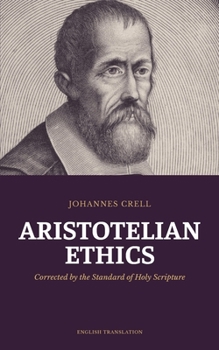
Aristotelian Ethics: Corrected by the Standard of Holy Scripture

Can Aristotle be a teacher of Christians - and where does that end?
Johannes Crell (1590-1633), rector of the academy at Rak w and one of the sharpest minds of Socinianism, takes up the Nicomachean Ethics point by point in this work and tests it against Holy Scripture. The result is neither a commentary nor a refutation, but something rarer: a correction. Crell holds fast to Aristotle so long as his observations bear weight, and contradicts him where Scripture teaches otherwise - with reasons, not with words of power.
In four parts and fifty-four chapters he treats of happiness, virtue, pleasure and friendship. What Aristotle calls measure and mean, Crell measures against what Scripture says of man: of his free choice, of the commandment of Christ in the Sermon on the Mount, of an end that reaches beyond a life well lived in this world. Where the philosopher defines virtue as the habit of the right measure, Crell asks whether that measure stands within man's power at all - and where Aristotle praises friendship among equals, he sets against it the love of enemies.
This edition contains:
the complete English translation of the Latin text after the Cosmopolis edition of 1681, worked sentence by sentence from the originalall 608 marginal glosses of the original print, set into the texta glossary of the key terms: virtue, happiness, habit, the mean, prudence, pleasure, friendship, the morally good, free choicean introductory preface on Crell, Rak w, and the aim of the bookNot included are the Life of Crell and the Dissertation on his ethics printed alongside it in the 1681 volume; this edition gives the Ethica Aristotelica itself.
Who this book is for: readers interested in ancient ethics, in the history of the Reformation, or in the question of how far philosophical reason and biblical revelation go together. For all who can bear a way of thinking that asks uncomfortable questions - not to destroy, but to clarify.
"Test everything; hold fast what is good." - 1 Thessalonians 5:21
Customer Reviews
ThriftBooks ® and the ThriftBooks ® logo are registered trademarks of Thrift Books Global, LLC
