


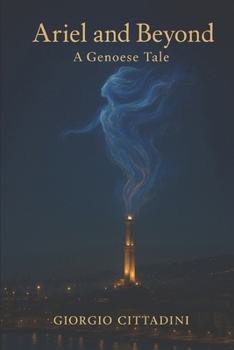
Ariel and Beyond: A Genoese Tale

"Ariel and Beyond" is a philosophical novel that blurs the boundaries between reality and fantasy, time and eternity, through the extraordinary encounter between Damian-a scientist disillusioned by the predictability of his discipline-and Ariel, the spirit of the air immortalized by Shakespeare. When Ariel appears in Damian's life after four hundred and fifteen years of wandering, a profound dialogue begins. Haunted by the relentless passage of time and a longing to transcend the limits of human existence, Damian finds in Ariel a reflective companion who leads him through essential questions: Can time be outwitted? Can the ghosts of the past take form? Where does illusion end and reality begin? Their conversations-ranging from philosophy to theology, from the nature of time to the art of magic-forge a bond that surpasses the master-servant dynamic. Ariel's otherworldly insight and his power to summon parallel realms spark Damian's inner transformation, forcing him to confront his obsessions and accept life's immutable laws. The novel unfolds in lyrical moments-such as the ritual of preparing coffee, a metaphor for perfection in the everyday-and in sharp reflections on the human condition. As past and present intertwine, and figures like Wallis and Helga drift through the narrative bearing echoes of alternate lives, the reader is invited to question the very fabric of reality. "Ariel and Beyond" blends the richness of European literary tradition with a contemporary sensibility, offering a meditation on love, death, memory, and the search for meaning in a universe ruled by indifferent laws. More than one man's philosophical journey, "Ariel and Beyond" is a meditation on solitude, time, desire, and the invisible threads that connect us. A novel for readers who value the elegance of ideas, the music of language, and the quiet beauty of closely observed moments.
Giorgio Cittadini was born in Palermo and pursued classical studies in Rome, where he graduated in Medicine and Surgery. He began his university career in Siena and later in Genoa, where he eventually became Director and Chair of the Department of Diagnostic Imaging, engaging in extensive teaching and research activity. In 1985, he published his first collection of poems, La gioia di cercare (The Joy of Seeking), followed in 1988 by Il pensiero del coccio (The Thought of the Shard). In 1989, his poetry collection La morte di Mirsilo (The Death of Myrsilus) was awarded the prestigious Rhegium Julii Prize. His novel Ariele e dopo (Ariel and After, 1999) was translated into Romanian by Ștefan Damian. In 1999, he published a translation of the celebrated poem Anabase by Saint-John Perse, accompanied by an extensive Reading Guide to the Work. Selected poems, translated into French, appeared in 2009 in the literary journals La Revue des Archers and Phoenix. In 2016 he published, in close collaboration with French semiologist and writer Jo lle Gardes, a translation of the Proven al poems by Saint-John Perse-Chronique and Chant pour un quinoxe. In 2019, he released the collection of poems Residui di tuono (Echoes of Thunder), which received third prize in the Intercontinental Literary Arts Competition Le Nove Muse. In 2022, he curated a new translation of Anabase, complete with a critical apparatus detailing its historical, structuralist, and poetic aspects. In 2023, he published a revised and expanded edition of Ariele e dopo - Il giorno del Bagatto (Ariel and After - The Magician's Day). In 2025, a selection of his poems was included in the anthology I Poeti di Ponte Vecchio. In 2025, he published two new collections: Poesie Disperse (Uncollected Poems), a retrospective poetic journey spanning four decades, and Moments for E., a bilingual Italian-English edition exploring the intimate geography of affection and memory.Customer Reviews
ThriftBooks® and the ThriftBooks® logo are registered trademarks of Thrift Books Global, LLC
