


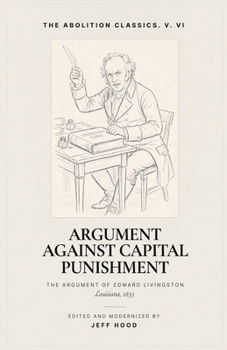
Argument Against Capital Punishment

In 1833, Edward Livingston handed the Louisiana legislature a complete criminal code with no death penalty in it. He was a former mayor of New York, a future Secretary of State under Andrew Jackson, and the most respected legal mind in the country. Jeremy Bentham built a correspondence around him. Victor Hugo counted him among the men of the age who had deserved most and best of mankind. The legislature never enacted the code.
Buried in its introduction is the argument reprinted here. Livingston starts further back than anyone had: not with whether executions work, but with whether the state ever received the right to kill at all. His answer is that the right exists only where nothing else will preserve life, that in any society able to build a prison that condition is never met, and that a state killing without necessity is not exercising a right but only a power. From there he takes apart deterrence with the historical record, and closes with the argument no defender of the gallows has answered in two centuries: the machinery convicts the wrong people, it does so most often to the poor and friendless, and death is the one sentence that cannot be undone.
This edition modernizes the prose of the 1843 New York pamphlet, with Livingston's argument, examples, and conclusions intact. The pamphlet's testimonials from clergy and statesmen are appended. The edition does not protect him. A front-matter reckoning states plainly that Livingston owned human beings, that Louisiana hanged the enslaved for revolt, and that he passed over it in silence, and argues for the text anyway.
Customer Reviews
ThriftBooks ® and the ThriftBooks ® logo are registered trademarks of Thrift Books Global, LLC
