


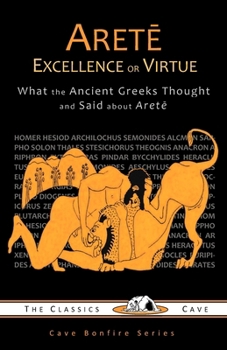
Arete: Excellence or Virtue
No Customer Reviews

Have you ever wondered what it means to be great? Excellent or virtuous? If so, then you'll want to hear what the ancient Greeks had to say about excellence or virtue since they thought and said a lot about it. Aretē Excellence or Virtue is a book that systematically presents what ancient Greek poets, historians, orators, and philosophers thought and said about the nature of excellence or virtue (what they termed aretē), all in their own words. And what did they say? In Homer's Iliad, Achilles' father urges him to "be the best"-that is, to possess aretē, excellence or virtue. In the Odyssey, old Laertes rejoices that his son, Odysseus, and his grandson, Telemachus, are "battling over aretē." Hundreds of years later, the poet Theognis of Megara counseled his friend to "wear himself out for the sake of aretē." Still later, the philosopher Socrates spent time with anyone who would talk with him about what it meant to cultivate aretē. And that's only the beginning of a conversation that lasted for well over a thousand years. That everyone in the ancient Greek world wanted to have and practice aretē is without doubt. It's what they hoped, prayed, and struggled for. It's what they admired and rewarded. The Spartan poet Tyrtaeus expressed the common view when he declared that aretē was the "best and noblest prize" one could win. Still, a question remains. As valuable as aretē was to them, what did the ancient Greeks mean by it? The goal of this book is to let them answer. After a brief introduction exploring the meaning of aretē and situating it in a more contemporary context, Aretē Excellence or Virtue presents what the ancient Greeks thought and said about aretē in their own words. We follow poets, playwrights, and historians on the what, who, and how of aretē. We listen to what all the major philosophers and schools of philosophy taught. And, finally, we hear selected passages from a number of orators that touch on aretē. No matter how you peruse Aretē, you will likely find your own views on human excellence and virtue shift as the Greeks influence your thinking about and even pursuit of aretē. Plus, you'll have an opportunity to practice aretē by following "A Plan of Life Aimed at Aretē" and engaging in the workbook and journal-like practice exercises found toward the end. More, in the glossary, you'll discover Greek terms that are pertinent to aretē. Lastly, you'll be pointed in the direction of further reading. What now? Grab a copy of Arete: Excellence or Virtue and see for yourself what the ancient Greeks have to say. We at the Cave believe your life will be enriched by doing so.
Format:Paperback
Language:English
ISBN:1943915156
ISBN13:9781943915156
Release Date:April 2021
Publisher:Classics Cave
Length:328 Pages
Weight:0.92 lbs.
Dimensions:0.7" x 5.5" x 8.5"
Customer Reviews
0 rating
Copyright © 2026 Thriftbooks.com Terms of Use
| Privacy Policy | Do Not
Sell/Share My Personal Information | Cookie Policy | Cookie Preferences | Accessibility Statement
ThriftBooks® and the ThriftBooks® logo are registered trademarks of Thrift Books Global, LLC
ThriftBooks® and the ThriftBooks® logo are registered trademarks of Thrift Books Global, LLC
