


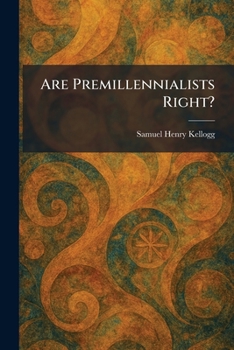
Are Premillennialists Right?

"Are Premillennialists Right?" is a rigorous and thoughtful exploration of one of the most debated topics in Christian eschatology. Samuel Henry Kellogg provides a scholarly yet accessible defense of the premillennial viewpoint, arguing that the biblical witness supports the literal return of Jesus Christ prior to the establishment of a millennial kingdom on earth.
In this work, Kellogg meticulously examines scriptural evidence, focusing on the interpretation of prophecy and the chronological sequence of end-times events. He addresses the theological tensions between premillennialism, postmillennialism, and amillennialism, offering a clear articulation of why the premillennial stance aligns with a faithful reading of the New Testament. The book serves as an important historical document for those interested in the development of evangelical thought and the evolution of prophetic interpretation during the late nineteenth and early twentieth centuries.
With its logical structure and focus on biblical authority, "Are Premillennialists Right?" remains a significant resource for students of theology, pastors, and laypeople seeking to understand the foundations of millennial hope. Kellogg's clear prose and deep conviction offer a compelling look at the doctrinal convictions that have shaped a major segment of modern Protestantism and continue to influence contemporary discussions on the return of Christ.
This work has been selected by scholars as being culturally important, and is part of the knowledge base of civilization as we know it. This work was reproduced from the original artifact, and remains as true to the original work as possible. Therefore, you may see the original copyright references, library stamps (as most of these works have been housed in our most important libraries around the world), and other notations in the work.
This work is in the public domain in the United States of America, and possibly other nations. Within the United States, you may freely copy and distribute this work, as no entity (individual or corporate) has a copyright on the body of the work.
As a reproduction of a historical artifact, this work may contain missing or blurred pages, poor pictures, errant marks, etc. Scholars believe, and we concur, that this work is important enough to be preserved, reproduced, and made generally available to the public. We appreciate your support of the preservation process, and thank you for being an important part of keeping this knowledge alive and relevant.
Customer Reviews
ThriftBooks ® and the ThriftBooks ® logo are registered trademarks of Thrift Books Global, LLC
