


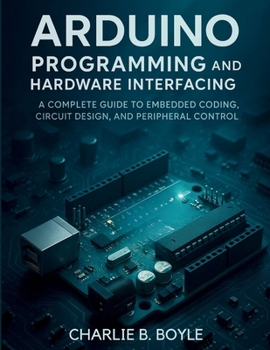
Arduino Uno Q Programming and Hardware Interfacing: A Complete Guide to Embedded Coding, Circuit Design, and Peripheral Control
No Customer Reviews

Have you ever looked at a microcontroller board and wondered what it's truly capable of beyond blinking a simple LED? Have you started a project with excitement, only to get stuck when hardware and software refused to cooperate? Or maybe you've asked yourself: How do professionals design reliable embedded systems that actually work outside the lab? If those questions sound familiar, this book was written with you in mind. Arduino Uno Q Programming and Hardware Interfacing is not just another beginner's walkthrough. It's a practical, in-depth guide designed to help you move from experimenting to engineering. Whether you're a student, hobbyist, technician, or engineer, this book bridges the gap between writing code and building dependable real-world electronic systems. Instead of overwhelming you with theory alone, Charlie B. Boyle takes you step by step through the logic behind embedded programming and circuit integration. You won't just learn what to connect - you'll understand why it works. What Makes This Book Different? Have you ever followed a tutorial that worked once, but left you confused about what was actually happening behind the scenes? This guide focuses on clarity and control. You'll explore: Structured embedded programming techniques Efficient use of digital and analog input/output Serial communication and data exchange principles Timing, interrupts, and precise control logic Sensor integration and signal conditioning Actuator control including motors, relays, and display modules Power management and circuit protection strategies Designing stable, noise-resistant hardware layouts Every concept is explained in a practical, conversational way - as if a mentor is guiding you at the workbench. From Coding to Real Hardware Confidence Have you ever written code that compiled perfectly but failed once connected to real components? That's where many makers struggle. Hardware introduces variables that software alone doesn't prepare you for - voltage fluctuations, signal noise, timing conflicts, and unexpected interference. This book shows you how to think like an embedded systems designer. You'll learn how to: Read and interpret circuit diagrams with confidence Select appropriate resistors, transistors, and interface components Protect sensitive electronics from damage Debug both software and hardware systematically Optimize performance for stability and efficiency Instead of trial and error, you'll build systems with intention. Built for Real-World Application Are you planning to build automation systems? Robotics prototypes? Smart control panels? Custom instrumentation? This guide equips you with the knowledge to confidently design and program reliable embedded solutions that go beyond simple demonstrations. You'll discover how to structure projects in a scalable way, manage resources effectively, and integrate multiple peripherals without creating chaos in your codebase. Who Is This Book For? Students studying electronics or embedded systems Hobbyists ready to move into advanced projects Engineers who want a structured refresher Makers looking to build robust, long-lasting designs Professionals developing small-scale control systems If you've ever wanted to stop guessing and start designing with confidence, this book gives you that foundation. A Practical, Human Approach Charlie B. Boyle writes in a direct and accessible style. Instead of drowning you in jargon, he explains complex ideas in clear, practical language. You'll feel like you're learning from someone who understands both the excitement and the frustration of embedded development.
Format:Paperback
Language:English
ISBN:B0GPM58LJR
ISBN13:9798249074999
Release Date:February 2026
Publisher:Independently Published
Length:302 Pages
Weight:1.55 lbs.
Dimensions:0.6" x 8.5" x 11.0"
Customer Reviews
0 rating
Copyright © 2026 Thriftbooks.com Terms of Use
| Privacy Policy | Do Not
Sell/Share My Personal Information | Cookie Policy | Cookie Preferences | Accessibility Statement
ThriftBooks® and the ThriftBooks® logo are registered trademarks of Thrift Books Global, LLC
ThriftBooks® and the ThriftBooks® logo are registered trademarks of Thrift Books Global, LLC
