


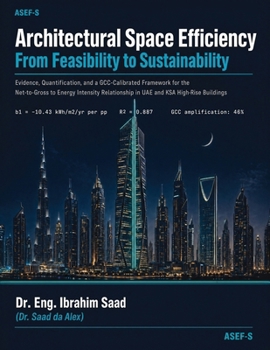
Architectural Space Efficiency: From Feasibility to Sustainability

Every square meter an architect loses to inefficient design becomes a permanent energy penalty the building will pay for the next 50 years.
Across the Gulf, buildings are losing significant net-to-gross floor area between concept and completion - and the region's climate turns that lost efficiency into an outsized energy and cost burden. Architectural Space Efficiency is the first practitioner guide to quantify exactly how much this costs, why UAE and KSA high-rise construction amplifies the effect, and what to do about it at every design stage.
Built on a rigorous research base spanning 34 international case buildings, expert interviews, and longitudinal tracking of real projects through five design stages, this book establishes the core evidence - a net-to-gross to energy intensity coefficient of -10.43 kWh/m /yr per percentage point, an R of 0.887, and a 46% GCC-specific amplification effect - and translates it into the ASEF-S Framework, a practical scoring and evaluation system architects, developers, and sustainability consultants can apply from concept sketch through authority submission.
Inside, you'll find:
The quantified relationship between net-to-gross ratio and annual building energy performance, in real cost and carbon termsWhy UAE and KSA high-rise buildings show a measurably larger efficiency penalty than global benchmarksA stage-by-stage breakdown of where space efficiency is typically lost - and how to stop itThe ASEF-S Design Evaluation Tool, in three ready-to-use formats for concept, schematic/developed design, and authority submission stagesRole-specific action checklists for architects, developers, and regulatorsWorked examples and typology-specific benchmarks for GCC high-rise practiceWritten for working professionals rather than academic audiences, this is a book meant to sit on a desk and be used - not shelved.
Customer Reviews
ThriftBooks ® and the ThriftBooks ® logo are registered trademarks of Thrift Books Global, LLC
