


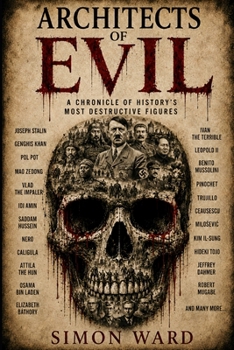
Architects of Evil: A Chronicle of History's Most Destructive Figures

ARCHITECTS OF EVIL
A Chronicle of History's Most Destructive Figures
History is filled with names that became synonymous with power, terror and death.
From ancient conquerors who built empires through slaughter to twentieth-century dictators who turned entire states into instruments of repression, Architects of Evil examines the people whose decisions and actions left some of the darkest marks on human history.
Across more than seven thousand years, this book travels from the ancient world to the modern era, exploring the lives, ambitions and crimes of rulers, conquerors, revolutionaries, military leaders and other figures associated with some of history's most devastating episodes.
Meet Genghis Khan, whose Mongol conquests transformed the map of Eurasia. Nero and Caligula, whose reigns became enduring symbols of Roman tyranny. Vlad the Impaler, whose reputation for spectacular violence became the foundation for one of history's most famous legends. Ivan the Terrible, Elizabeth B thory, Christopher Columbus, Hern n Cort s and Francisco Pizarro appear alongside colonial rulers whose actions had consequences reaching far beyond their own lifetimes.
The story then moves into the age of empire and industrialised warfare: Leopold II, Cecil Rhodes, Enver Pasha, Talaat Pasha and Kaiser Wilhelm II. From there it enters the twentieth century and the extraordinary scale of destruction associated with Adolf Hitler, Heinrich Himmler, Reinhard Heydrich, Adolf Eichmann, Joseph Stalin, Benito Mussolini, Mao Zedong, Pol Pot and other authoritarian leaders.
The book continues through the Cold War and into the modern era, examining figures including Kim Il-sung and Kim Jong-il, Nicolae Ceaușescu, Rafael Trujillo, Augusto Pinochet, Ferdinand Marcos, Suharto, Saddam Hussein, Idi Amin, Slobodan Milosevic, Omar al-Bashir and others.
But Architects of Evil is not simply a catalogue of atrocities.
It explores how power becomes violence, how institutions can be transformed into mechanisms of persecution, how propaganda can shape historical memory, and how ordinary societies can become trapped inside systems built around fear, obedience and dehumanisation.
Where historical evidence is uncertain, disputed or shaped by propaganda and legend, the book acknowledges that uncertainty rather than presenting questionable figures as unquestionable fact. Death tolls, ancient accounts and contested historical claims are treated with particular care.
The result is a sweeping journey through some of humanity's darkest chapters - from ancient battlefields and imperial courts to concentration camps, revolutionary regimes, colonial territories and modern police states.
These are stories of ambition, ideology, conquest, persecution and mass death.
But they are also stories about power - how it is gained, how it is maintained, and what can happen when those who possess it face few meaningful limits.
Fifty figures. Thousands of years of history. Countless lives changed forever.
Architects of Evil confronts the darkest question of all:
How does one human being acquire the power to destroy so many others - and why does the world sometimes fail to stop them?
Customer Reviews
ThriftBooks ® and the ThriftBooks ® logo are registered trademarks of Thrift Books Global, LLC
