


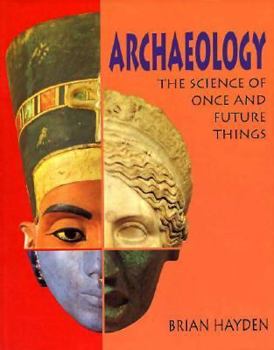
Archaeology: The Science of Once and Future Things


Select Format
Select Condition 
Book Overview
Brian Hayden offers a fresh approach to the study of archaeology at an introductory level. In archaeology he sets out a broad overview of the subject emphasizing the most interesting problems and... This description may be from another edition of this product.
Format:Paperback
Language:English
ISBN:0716723077
ISBN13:9780716723073
Release Date:January 1992
Publisher:W H Freeman & Co
Length:496 Pages
Weight:1.85 lbs.
Dimensions:9.3" x 1.0" x 7.3"
Customer Reviews
3 ratings
Wonderful, richly informative, and fun to read.
Published by Thriftbooks.com User , 21 years ago
While this is really a marvelous book, there is something that I need to address right from the start, and that's this: some might find the title a bit misleading. While appearing as a basic introductory textbook on the subject of archaeology, there is really very little in this book on the practical field skills needed by an aspiring archaeologist. If you're looking for how-to information such as how to properly survey a site or conduct an excavation, this isn't the volume for you.If I were to sum up what this book specializes in it would be this: Hayden takes the evidence produced from archaeology and cultural anthropology and creates an eminently readable and yet richly detailed presentation of the basic concepts (different from skills) derived from archaeology and seeks to create an understanding of human cultural evolution based on those concepts and the archaeological record.Hayden starts with hunter-gatherer cultures and then moves on the development of chiefdoms and then the development of what could be called "civilization" or "states." Nearly 200 pages of the book are devoted to these different kinds of social organization with a solid amount of information that details their specific traits and the transitions involved. The beginnings of social stratification, the development of monumental architecture, the significance of elaborate burial practices, and so much more are detailed wonderfully.In essence, this book provides a great explanation for how we got from hunter-gatherer cultures to here, with a lot of detail on what transpired in between. And while much of our knowledge in these areas is necessarily speculative, Hayden provides strong arguments and a wealth of details to support his contentions. I found this book to be a very enjoyable read, much more engaging than many textbooks on the subject. Of course, I'm very interested in these topics and have already read extensively on them so that certainly helps. While this is a book that can be studied closely (and deserves to be) it is also a book that can be browsed by the intelligent and curious for pleasure. But if you have zero background in these issues a more gentle start could be more appropriate.Other reviewers have noted Hayden's bias towards cultural materialism, and I agree with the points they've raised. Instead of re-hashing their points I'll just direct you to their reviews. This issue is important and of course the reader would benefit from other interpretations. Hayden is pushing one view-point, but it's not concealed and he makes a very good case for it.The only part of the book that becomes a let-down is the last chapters where Hayden discusses the current state of global culture with a lot of ominous talk about global nuclear warfare. Considering the book was published in 1992, it's likely that most of the thinking and writing in this volume occurred in the 1980s where this seemed a more pressing concern. It's here where I think Hayden really isn't a
Not a bedtime book, but a good intro into Archaeology
Published by Thriftbooks.com User , 26 years ago
I got Hayden's book through a friend who took his course at Simon Fraser University. I originally wanted to read through it before starting in on similar courses, simply to have a bit of a background on the subject. I found that the book is definitely one that you want to STUDY not just READ. It takes a considerable amount of time to go through the book, and Hayden doesn't really explore other issues besides the one he is biased to. He states his points of view, and doesn't go into other just as important views. I did, however, find his book to be substantially informative, and will be interested to read future works. I doubt if I will take any of his courses at SFU, but would be ecstatic to meet and talk with him about our shared interest.
digging up cultural evolution
Published by Thriftbooks.com User , 27 years ago
Hayden's book contains a good overview of some important aspects of archaeology, but it is more an interpretation of archaeology from a particular perspective than it is a "textbook." It makes for more enjoyable reading than many introductions to archaeology, but stresses only one point of view ( cultural materialism, and specifically, economic determinism ). Cognitivist or "contextual" approaches are hardly discussed, and never fairly. However, Hayden is not at all shy about stating his bias, and he even gives us his own materialist interpretation of feminism as an excellent example of how he views the past. Those who believe that ideas and human values have played any great important part in history will sometimes find their views being riduculed in a rather ridiculus manner. Still, to gain an understanding of the cultural materialist viewpoint (which still seems the dominant in archaeology), it makes good sense to read someone as dogmatic as Hayden. And Hayden knows how to make his dogma into a good read.
Copyright © 2026 Thriftbooks.com Terms of Use
| Privacy Policy | Do Not
Sell/Share My Personal Information | Cookie Policy | Cookie Preferences | Accessibility Statement
ThriftBooks® and the ThriftBooks® logo are registered trademarks of Thrift Books Global, LLC
ThriftBooks® and the ThriftBooks® logo are registered trademarks of Thrift Books Global, LLC
