


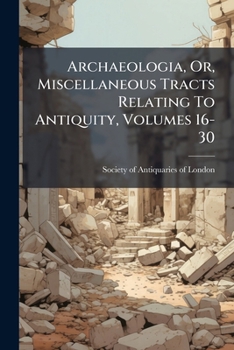
Archaeologia, Or, Miscellaneous Tracts Relating To Antiquity, Volumes 16-30

This extensive collection, "Archaeologia, Or, Miscellaneous Tracts Relating To Antiquity, Volumes 16-30," presents a detailed record of archaeological discoveries and historical research conducted under the auspices of the Society of Antiquaries of London. Spanning several decades, these volumes offer invaluable insights into the material culture and historical narratives of Britain and Europe. Each volume contains a series of articles, reports, and illustrations detailing archaeological sites, ancient artifacts, and historical documents examined by leading antiquarians of the time.
Researchers and historians will find a wealth of primary source material, providing a unique window into the methodologies and interpretations of early archaeological studies. The collection showcases detailed investigations into various aspects of antiquity, from Roman settlements and medieval architecture to prehistoric monuments and ancient burial sites. "Archaeologia" remains an essential resource for anyone interested in the history of archaeology and the ongoing effort to understand our past.
This work has been selected by scholars as being culturally important, and is part of the knowledge base of civilization as we know it. This work was reproduced from the original artifact, and remains as true to the original work as possible. Therefore, you will see the original copyright references, library stamps (as most of these works have been housed in our most important libraries around the world), and other notations in the work.
This work is in the public domain in the United States of America, and possibly other nations. Within the United States, you may freely copy and distribute this work, as no entity (individual or corporate) has a copyright on the body of the work.
As a reproduction of a historical artifact, this work may contain missing or blurred pages, poor pictures, errant marks, etc. Scholars believe, and we concur, that this work is important enough to be preserved, reproduced, and made generally available to the public. We appreciate your support of the preservation process, and thank you for being an important part of keeping this knowledge alive and relevant.
Customer Reviews
ThriftBooks ® and the ThriftBooks ® logo are registered trademarks of Thrift Books Global, LLC
