


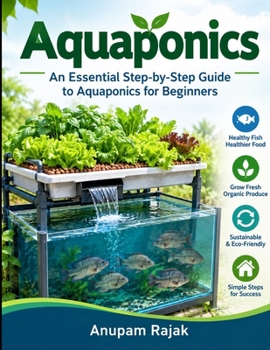
Aquaponics: An Essential Step-by-Step Guide to Aquaponics for Beginners
No Customer Reviews

Aquaponics represents an exciting meeting point between aquaculture and plant cultivation. It offers a practical way to grow fish and plants together by allowing natural biological processes to recycle nutrients and water within a connected production system. For beginners, however, aquaponics can initially appear complicated. There are fish to care for, plants to grow, pumps and pipes to manage, water quality to monitor, and beneficial microorganisms that must establish and remain healthy. Understanding how all these parts work together is the key to building a successful system.
This book, Aquaponics: An Essential Step-by-Step Guide to Aquaponics for Beginners, has been written to make that learning process easier, clearer, and more approachable.
The purpose of this book is not simply to explain what aquaponics is, but to help readers understand how to think about an aquaponic system. A successful aquaponic garden is not just a collection of tanks, pipes, pumps, grow beds, fish, and plants. It is a living ecosystem in which every component influences the others. Fish provide nutrients through their waste, microorganisms transform those nutrients into forms plants can use, plants absorb nutrients from the water, and the cleaned water returns to the fish. The grower acts as the manager of this entire relationship.
For this reason, the book begins with the fundamental principles of aquaponics before moving toward construction, operation, maintenance, troubleshooting, and advanced techniques. Readers are introduced to the aquaponic ecosystem, the nitrogen cycle, beneficial bacteria, water quality, fish management, plant selection, feeding, harvesting, and food safety. Later chapters explore system optimization, small-scale business opportunities, sustainability, and the future of aquaponic food production.
A central message throughout this book is that simplicity is one of the greatest advantages for a beginner. It is easy to become interested in complicated designs, automation, sensors, sophisticated filtration equipment, and large production systems. These technologies can be useful, but they should support biological understanding rather than replace it. A small and well-managed system can teach more than a large system that the grower does not understand.
Aquaponics also teaches an important lesson about balance. Too many fish can produce more waste than the biological and plant components can process. Too little aeration can affect fish and microorganisms. Poor water quality can damage both fish and plants. Overfeeding can increase waste and reduce system stability. Insufficient plant growth can result in nutrient accumulation, while excessive plant demand may create nutrient deficiencies. Every action in one part of the system can create consequences elsewhere.
Learning to recognize these relationships is more valuable than memorizing isolated instructions.
Another important goal of this book is to encourage responsible and sustainable food production. Aquaponics can reduce water consumption compared with many conventional growing approaches because water is continuously recirculated. It can also make productive use of limited spaces and provide opportunities for household food production, education, community projects, and small-scale entrepreneurship. Nevertheless, aquaponics is not automatically sustainable simply because it recirculates water. Pumps, aeration, fish feed, construction materials, heating or cooling, lighting, and other inputs require resources. True sustainability requires thoughtful design and responsible management.
The book therefore considers sustainability from several perspectives, including water conservation, energy efficiency, responsible fish management, nutrient recycling, waste reduction, food safety, economic practicality, and long-term system resilience.
This book, Aquaponics: An Essential Step-by-Step Guide to Aquaponics for Beginners, has been written to make that learning process easier, clearer, and more approachable.
The purpose of this book is not simply to explain what aquaponics is, but to help readers understand how to think about an aquaponic system. A successful aquaponic garden is not just a collection of tanks, pipes, pumps, grow beds, fish, and plants. It is a living ecosystem in which every component influences the others. Fish provide nutrients through their waste, microorganisms transform those nutrients into forms plants can use, plants absorb nutrients from the water, and the cleaned water returns to the fish. The grower acts as the manager of this entire relationship.
For this reason, the book begins with the fundamental principles of aquaponics before moving toward construction, operation, maintenance, troubleshooting, and advanced techniques. Readers are introduced to the aquaponic ecosystem, the nitrogen cycle, beneficial bacteria, water quality, fish management, plant selection, feeding, harvesting, and food safety. Later chapters explore system optimization, small-scale business opportunities, sustainability, and the future of aquaponic food production.
A central message throughout this book is that simplicity is one of the greatest advantages for a beginner. It is easy to become interested in complicated designs, automation, sensors, sophisticated filtration equipment, and large production systems. These technologies can be useful, but they should support biological understanding rather than replace it. A small and well-managed system can teach more than a large system that the grower does not understand.
Aquaponics also teaches an important lesson about balance. Too many fish can produce more waste than the biological and plant components can process. Too little aeration can affect fish and microorganisms. Poor water quality can damage both fish and plants. Overfeeding can increase waste and reduce system stability. Insufficient plant growth can result in nutrient accumulation, while excessive plant demand may create nutrient deficiencies. Every action in one part of the system can create consequences elsewhere.
Learning to recognize these relationships is more valuable than memorizing isolated instructions.
Another important goal of this book is to encourage responsible and sustainable food production. Aquaponics can reduce water consumption compared with many conventional growing approaches because water is continuously recirculated. It can also make productive use of limited spaces and provide opportunities for household food production, education, community projects, and small-scale entrepreneurship. Nevertheless, aquaponics is not automatically sustainable simply because it recirculates water. Pumps, aeration, fish feed, construction materials, heating or cooling, lighting, and other inputs require resources. True sustainability requires thoughtful design and responsible management.
The book therefore considers sustainability from several perspectives, including water conservation, energy efficiency, responsible fish management, nutrient recycling, waste reduction, food safety, economic practicality, and long-term system resilience.
Format:Paperback
Language:English
ISBN:B0HHZ719WS
ISBN13:9798172272844
Release Date:September 2026
Publisher:Independently Published
Length:552 Pages
Weight:2.78 lbs.
Dimensions:1.1" x 8.5" x 11.0"
Customer Reviews
0 rating
Copyright © 2026 Thriftbooks.com
Terms of Use | Privacy Policy | Do Not Sell/Share My Personal Information | Cookie Notice | Cookie Preferences | Accessibility Statement
ThriftBooks ® and the ThriftBooks ® logo are registered trademarks of Thrift Books Global, LLC
ThriftBooks ® and the ThriftBooks ® logo are registered trademarks of Thrift Books Global, LLC
