


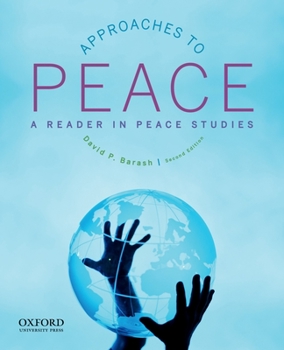
Approaches to Peace: A Reader in Peace Studies


Select Format
Select Condition 
Book Overview
"For those endeavoring to approach peace, there is no shortage of challenges, practical as well as intellectual. Fortunately, there is also no shortage of inspiration and insight."--From the preface Approaches to Peace: A Reader in Peace Studies, Second Edition, provides a unique and interdisciplinary sampling of key articles and short literary selections focusing on the diverse facets of peace and conflict studies. Featuring both classic and contemporary work, it enables students to read highly influential articles while also introducing them to the most current perspectives in the field. Timeless classics from Leo Tolstoy, the Bhagavad Gita, Martin Luther King, Jr., Gandhi, and Henry David Thoreau are included alongside contemporary pieces by Johan Galtung, Betty Reardon, and many others. Updated to address current concerns, the second edition incorporates seventeen new articles, including selections from Al Gore on climate change, Jeffrey Sachs on Third World economies, and Desmond Tutu on reconciliation. A new chapter on terrorism offers work from Eqbal Ahmad, Richard Falk, Samuel Huntington, and others.
Ideal on its own as a foundation text in any introductory peace studies course, Approaches to Peace, Second Edition, is also compact enough to use as a supplement with more specialized readings. Each selection is prefaced by a short introduction highlighting the author's background, the work's historical context, and the selection's significance in terms of the "big picture." Study questions and a list of suggested readings at the end of each selection also provide useful resources for students.
Ideal on its own as a foundation text in any introductory peace studies course, Approaches to Peace, Second Edition, is also compact enough to use as a supplement with more specialized readings. Each selection is prefaced by a short introduction highlighting the author's background, the work's historical context, and the selection's significance in terms of the "big picture." Study questions and a list of suggested readings at the end of each selection also provide useful resources for students.
Format:Paperback
Language:English
ISBN:0195382862
ISBN13:9780195382860
Release Date:August 2009
Publisher:Oxford University Press, Incorporated
Length:304 Pages
Weight:1.16 lbs.
Dimensions:7.4" x 0.5" x 9.1"
Related Subjects
Ancient & Classical Literature Criticism & Theory Education & Reference Greek History History & Criticism Humanities International Relations Language Arts Literature Military Political Science Politics & Government Politics & Social Sciences Reference Social Sciences Specific Topics Treaties War & PeaceCustomer Reviews
1 rating
One of the best, but still falls a bit short
Published by Thriftbooks.com User , 22 years ago
I've used David Barash's _Approaches to Peace_ several times in my college classes on peace and justice. This is unusual in itself, because I rarely use anthologies, preferring instead to go straight to the original sources themselves. I like Barash's approach, though, because it tries to be inclusive as possible. The anthology begins by looking at the definitions and possible causes of war, moves on to analyses of how to prevent war (negative peace), then to considerations of how to create structures of justice that eliminate the necessary conditions for war (positive peace). The rest of the book is devoted to readings that discuss nonviolence, religious pacifism, and historical peace movements. All of these general categories are exactly what one would want in a "peace studies" text.The problem is that the readings included in each category aren't always the best (or at least aren't the ones I would've selected). The single best two sets of readings are in the chapters on positive peace and nonviolence. The single worst (and I do mean *worst*!) set of readings are when Barash deals with religious pacifism (it's as if he feels uncomfortable in this arena). In the section on peace movements, Vaclav Havel's essay is the single best piece, but one wonders why it (and perhaps the entire chapter) doesn't serve as the prologue to the anthology.Still, no anthology perfectly pleases everyone. Barash's is the best one out there I've discovered. Perhaps some changes will be made in a second edition. Regardless, I highly recommend this book.
Copyright © 2026 Thriftbooks.com
Terms of Use | Privacy Policy | Do Not Sell/Share My Personal Information | Cookie Policy | Cookie Preferences | Accessibility Statement
ThriftBooks ® and the ThriftBooks ® logo are registered trademarks of Thrift Books Global, LLC
ThriftBooks ® and the ThriftBooks ® logo are registered trademarks of Thrift Books Global, LLC
