


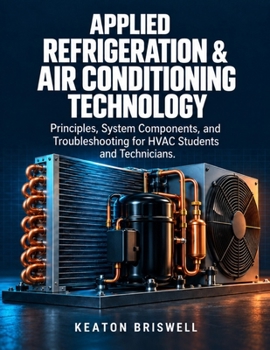
Applied Refrigeration & Air Conditioning Technology: Principles, System Components, and Troubleshooting for HVAC Students and Technicians

Understand how refrigeration and air conditioning systems work-and how to interpret the evidence when performance changes.
Applied Refrigeration & Air Conditioning Technology connects the science of heat, pressure, energy, and moisture with the components and operating conditions found in HVAC systems. Written for students and technicians, it develops the calculations and reasoning needed to move from individual readings to a defensible explanation of system behavior.
Across 15 chapters, the book covers measurement and safe working practices; thermodynamics and refrigerant states; heat transfer; the vapor-compression cycle; psychrometrics; refrigerants and lubricants; compressors; condensers and evaporators; expansion devices and piping; electrical fundamentals and controls; air distribution and ventilation; cooling loads and equipment selection; heat pumps; commissioning and maintenance; and troubleshooting and energy improvement.
Inside, readers will find:
- 50 technical figures that clarify system arrangements, processes, and performance relationships.
- Worked examples with calculations, units, assumptions, and interpreted results.
- Graded practice problems and answers to 45 selected problems.
- SI-based explanations with selected US customary unit conversions.
- A glossary, three practical appendices, and a subject index.
The book emphasizes distinctions that matter in practice: gauge versus absolute pressure, dry-air versus total-air mass, refrigerant-cycle versus whole-system performance, and observed symptoms versus supported causes. Measurement records and commissioning examples show how to preserve the conditions and boundaries behind a calculation.
Basic algebra and introductory physics provide a useful starting point. Readers can study the chapters in sequence or use individual topics to reinforce classroom learning and technical understanding.
Build a clearer understanding of the system from the first measurement to the final performance assessment.
Customer Reviews
ThriftBooks ® and the ThriftBooks ® logo are registered trademarks of Thrift Books Global, LLC
