


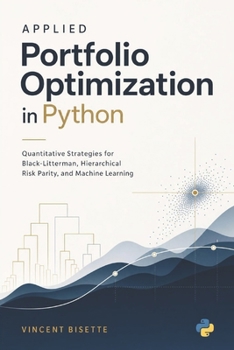
Applied Portfolio Optimization in Python: Quantitative Strategies for Black-Litterman, Hierarchical Risk Parity, and Machine Learning

Master the modern quantitative toolkit required to transition portfolio construction from theoretical frameworks into production-ready Python workflows.
Traditional mean-variance optimization often struggles under real-market conditions, frequently producing unstable allocations, extreme position weights, and high sensitivity to estimation error. Applied Portfolio Optimization in Python bridges the gap between financial theory and practical execution, providing a rigorous roadmap for implementing advanced asset allocation techniques that address the structural limits of classical Markowitz models.
Designed for quantitative analysts, portfolio managers, financial engineers, and algorithmic traders, this handbook provides clear code architectures and systematic explanations for building robust risk-managed portfolios. Rather than focusing purely on abstract mathematics, each chapter walks through the algorithmic design, data preparation, backtesting dynamics, and execution trade-offs inherent in modern institutional management.
Inside, you will explore:
The Limits of Mean-Variance & MVO Dynamics: Deconstruct corner solutions, estimation risk, and the practical challenges of covariance matrix inversion in live trading environments.Black-Litterman Portfolio Optimization: Combine market equilibrium priors with custom investor views to generate stable, intuitive asset weights without extreme allocation swings.Hierarchical Risk Parity (HRP): Implement graph-theory and machine learning clustering concepts to allocate risk across asset hierarchies without relying on matrix inversion.Machine Learning for Covariance Estimation: Apply matrix denoising, non-linear shrinkage, and distance-based clustering algorithms to clean noise from real-world financial time series.Robust Optimization & Factor Models: Incorporate transaction costs, turnover constraints, and factor-based risk budgets directly into optimization routines.Python Quantitative Ecosystem: Utilize modern data structures using Python libraries to build efficient backtesting engines, performance attribution tools, and continuous risk monitoring pipelines.Whether you are upgrading an existing quantitative trading strategy or building an institutional risk management framework from scratch, Applied Portfolio Optimization in Python delivers the code, mathematical foundations, and practical insights necessary to deploy production-grade allocation algorithms with confidence.
Customer Reviews
ThriftBooks ® and the ThriftBooks ® logo are registered trademarks of Thrift Books Global, LLC
