


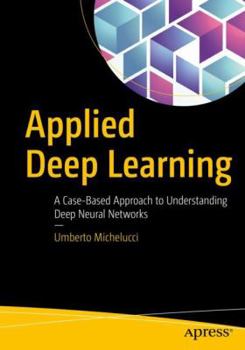
Applied Deep Learning: A Case-Based Approach to Understanding Deep Neural Networks
No Customer Reviews

Chapter 1: Introduction Chapter Goal: Describe the book, the TensorFlow infrastructure, give instructions on how to setup a system for deep learning projectsNo of pages 30-50Sub -Topics1. Goal of the book2. Prerequisites3. TensorFlow Jupyter Notebooks introduction4. How to setup a computer to follow the book (docker image?)5. Tips for TensorFlow development and libraries needed (numpy, matplotlib, etc.)6. The problem of vectorization of code and calculations7. Additional resources
Chapter 2: Single NeuronsChapter Goal: Describe what you can achieve with neural networks with just one neuron.No of pages: 50-70Sub -Topics8. Overview of different parts of a neuron9. Activation functions (ReLu, sigmoid, modified ReLu, etc.) and their difference (which one is for which task better)10. The new google activation function SWISH (https: //arxiv.org/abs/1710.05941?utm_campaign=Artificial%2BIntelligence%2Band%2BDeep%2BLearning%2BWeekly&utm_medium=email&utm_source=Artificial_Intelligence_and_Deep_Learning_Weekly_35) 11. Optimization algorithm discussion (gradient descent)12. Linear regression13. Basic Tensorflow introduction14. Logistic regression15. Regression (linear and logistic) with tensorflow16. Practical case discussed in details17. The difference between regression and classification for one neuron18. Tips for TensorFlow implementation
Chapter 3: Fully connected Neural Network with more neuronsChapter Goal: Describe what is a fully connected neural network and how to implement one (with one or more layers, etc.), and how to perform classification (binary and multi-class and regression)No of pages: 30-50Sub -Topics1. What is a tensor2. Dimensions of involved tensors (weights, input, etc.) (with tips on TensorFlow implementation)3. Distinctions between features and labels4. Problem of initialization of weights (random, constant, zeros, etc.)5. Second tutorial on tensorflow6. Practical case discussed in details7. Tips for TensorFlow implementation8. Classification and regression with such networks and how the output layer is different9. Softmax for multi-class classification10. Binary classification
Chapter 4: Neural networks error analysisChapter Goal: Describe the problem of identifying the sources of errors (variance, bias, data skewed, not enough data, overfitting, etc.)No of pages: 50-70Sub -Topics1. Train, dev and test dataset - why do we need three? Do we need four? What can we detect with different datasets and how to use them or size them?2. Sources of errors (overfitting, bias, variance, etc.)3. What is overfitting, a discussion4. Why is overfitting important with neural networks?5. Practical case discussion6. A guide on how to perform error analysis7. A practical example with a complete error analysis8. The problem of different datasets (train, dev, test, etc.) coming from different distributions9. Data augmentation techniques and examples10. How to deal with too few data11. How to split the datasets (train, dev, test)? Not 60/20/20 but more 98/1/1 when we have a LOT of data.12. Tips for TensorFlow implementation
Chapter 5: Dropout techniqueChapter Goal: Describe what dropout is, when to employ itNo of pages: 30-50Sub -Topics1. What is dropout ?2. When we need to
Chapter 2: Single NeuronsChapter Goal: Describe what you can achieve with neural networks with just one neuron.No of pages: 50-70Sub -Topics8. Overview of different parts of a neuron9. Activation functions (ReLu, sigmoid, modified ReLu, etc.) and their difference (which one is for which task better)10. The new google activation function SWISH (https: //arxiv.org/abs/1710.05941?utm_campaign=Artificial%2BIntelligence%2Band%2BDeep%2BLearning%2BWeekly&utm_medium=email&utm_source=Artificial_Intelligence_and_Deep_Learning_Weekly_35) 11. Optimization algorithm discussion (gradient descent)12. Linear regression13. Basic Tensorflow introduction14. Logistic regression15. Regression (linear and logistic) with tensorflow16. Practical case discussed in details17. The difference between regression and classification for one neuron18. Tips for TensorFlow implementation
Chapter 3: Fully connected Neural Network with more neuronsChapter Goal: Describe what is a fully connected neural network and how to implement one (with one or more layers, etc.), and how to perform classification (binary and multi-class and regression)No of pages: 30-50Sub -Topics1. What is a tensor2. Dimensions of involved tensors (weights, input, etc.) (with tips on TensorFlow implementation)3. Distinctions between features and labels4. Problem of initialization of weights (random, constant, zeros, etc.)5. Second tutorial on tensorflow6. Practical case discussed in details7. Tips for TensorFlow implementation8. Classification and regression with such networks and how the output layer is different9. Softmax for multi-class classification10. Binary classification
Chapter 4: Neural networks error analysisChapter Goal: Describe the problem of identifying the sources of errors (variance, bias, data skewed, not enough data, overfitting, etc.)No of pages: 50-70Sub -Topics1. Train, dev and test dataset - why do we need three? Do we need four? What can we detect with different datasets and how to use them or size them?2. Sources of errors (overfitting, bias, variance, etc.)3. What is overfitting, a discussion4. Why is overfitting important with neural networks?5. Practical case discussion6. A guide on how to perform error analysis7. A practical example with a complete error analysis8. The problem of different datasets (train, dev, test, etc.) coming from different distributions9. Data augmentation techniques and examples10. How to deal with too few data11. How to split the datasets (train, dev, test)? Not 60/20/20 but more 98/1/1 when we have a LOT of data.12. Tips for TensorFlow implementation
Chapter 5: Dropout techniqueChapter Goal: Describe what dropout is, when to employ itNo of pages: 30-50Sub -Topics1. What is dropout ?2. When we need to
Format:Paperback
Language:English
ISBN:1484237897
ISBN13:9781484237892
Release Date:September 2018
Publisher:Apress
Length:410 Pages
Weight:1.65 lbs.
Dimensions:0.9" x 7.0" x 10.0"
Customer Reviews
0 rating
Copyright © 2026 Thriftbooks.com Terms of Use
| Privacy Policy | Do Not
Sell/Share My Personal Information | Cookie Policy | Cookie Preferences | Accessibility Statement
ThriftBooks® and the ThriftBooks® logo are registered trademarks of Thrift Books Global, LLC
ThriftBooks® and the ThriftBooks® logo are registered trademarks of Thrift Books Global, LLC
