


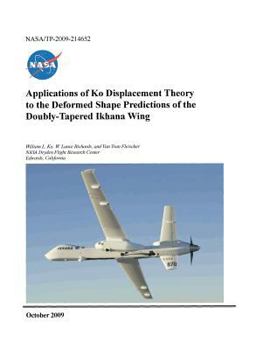
Applications of Ko Displacement Theory to the Deformed Shape Predictions of the Doubly-Tapered Ikhana Wing
No Customer Reviews

The Ko displacement theory, formulated for weak nonuniform (slowly changing cross sections) cantilever beams, was applied to the deformed shape analysis of the doubly-tapered wings of the Ikhana unmanned aircraft. The two-line strain-sensing system (along the wingspan) was used for sensing the bending strains needed for the wing-deformed shapes (deflections and cross-sectional twist) analysis. The deflection equation for each strain-sensing line was expressed in terms of the bending strains evaluated at multiple numbers of strain-sensing stations equally spaced along the strain-sensing line. For the preflight shape analysis of the Ikhana wing, the strain data needed for input to the displacement equations for the shape analysis were obtained from the nodal-stress output of the finite-element analysis. The wing deflections and cross-sectional twist angles calculated from the displacement equations were then compared with those computed from the finite-element computer program. The Ko displacement theory formulated for weak nonlinear cantilever beams was found to be highly accurate in the deformed shape predictions of the doubly-tapered Ikhana wing. Ko, William L. and Richards, W. Lance and Fleischer, Van Tran Armstrong Flight Research Center
Format:Paperback
Language:English
ISBN:179391981X
ISBN13:9781793919816
Release Date:January 1
Publisher:Independently Published
Length:32 Pages
Weight:0.22 lbs.
Dimensions:0.1" x 8.5" x 11.0"
Customer Reviews
0 rating
Copyright © 2025 Thriftbooks.com
Terms of Use | Privacy Policy | Do Not Sell/Share My Personal Information | Cookie Policy | Cookie Preferences | Accessibility Statement
ThriftBooks ® and the ThriftBooks ® logo are registered trademarks of Thrift Books Global, LLC
ThriftBooks ® and the ThriftBooks ® logo are registered trademarks of Thrift Books Global, LLC
