


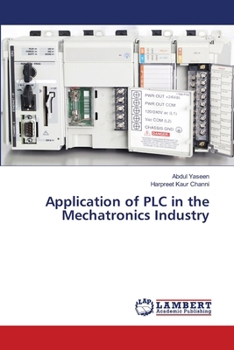
Application of PLC in the Mechatronics Industry
No Customer Reviews

A PLC programme is a digital operational microprocessor-based controller that stores instructions in a programmable memory and utilises those instructions to perform a variety of logical, sequential, temporal, numerical, and arithmetic operations in order to regulate mechanical and electronic systems. PLCs have numerous functions like a PC. They both have a power supply, CPU, I/O, RAM, and operating software (a distinct one). A PLC can execute discrete and continuous operations that a PC can't, and it's better suited to industrial settings. A PLC is a 'ruggedized' digital computer that handles electromechanical operations in industry. Industry 4.0 and the industrial internet of things will boost PLCs' popularity. PLCs must link to the cloud through MQTT and to databases via SQL for these motions. PLCs will become more significant in machine automation. Most PLCs can be programmed using a computer and software. IEC 61131-3 specifies five PLC languages. Three of these languages employ graphical programming interfaces, while two use text. Ladder logic is a popular PLC programming language.
Format:Paperback
Language:English
ISBN:6205632403
ISBN13:9786205632406
Release Date:January 2023
Publisher:LAP Lambert Academic Publishing
Length:60 Pages
Weight:0.22 lbs.
Dimensions:0.1" x 6.0" x 9.0"
Customer Reviews
0 rating
Copyright © 2026 Thriftbooks.com Terms of Use
| Privacy Policy | Do Not
Sell/Share My Personal Information | Cookie Policy | Cookie Preferences | Accessibility Statement
ThriftBooks® and the ThriftBooks® logo are registered trademarks of Thrift Books Global, LLC
ThriftBooks® and the ThriftBooks® logo are registered trademarks of Thrift Books Global, LLC
